SOUNDS
Chapter 1:
When Songs Became a Business
Chapter 2:
Making Hits
Chapter 3:
Music Without Musicians
Chapter 4
The Traffic in Voices
Chapter 5
Musical Properties
Chapter 6
Perfect Pitch
Chapter 7
The Black Swan
Chapter 8
The Musical Soundscape of Modernity
Epilogue
SELLING SOUNDS
Chapter 7: The Black Swan
The following is a sampling of recordings issued on the Black Swan label, whose complex history is explored in Chapter Seven.
Recordings marked with an asterisk are courtesy of the Archives of Traditional Music, Indiana University.
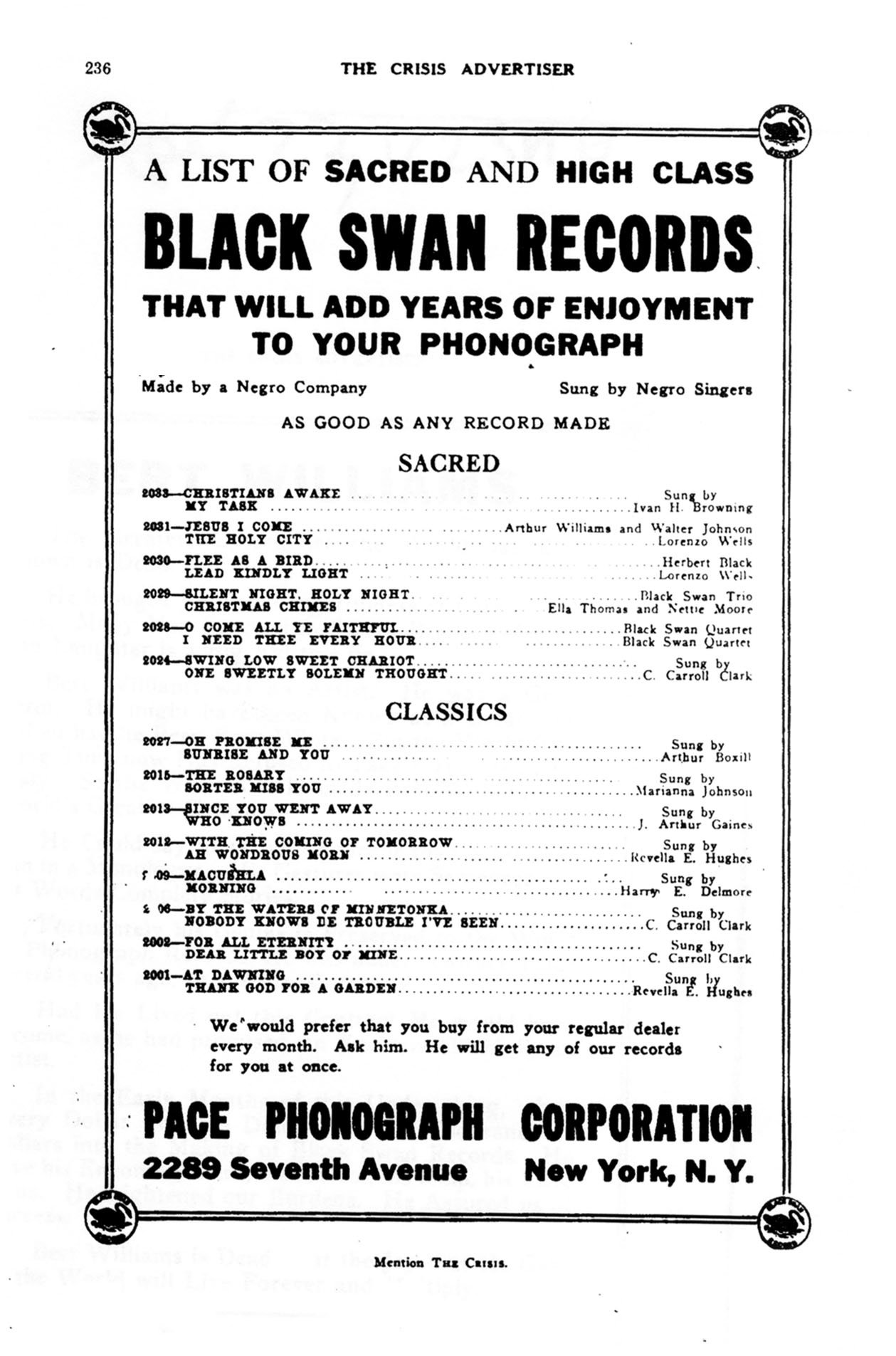
The following are some of Black Swan’s “serious” or “high-class” recordings, which differentiated Black Swan from other record companies. (Included here are several religious recordings, one of which, “Ain’t It a Shame,” by the Four Harmony Kings, would not, strictly speaking, have always been grouped in the high-class category.)
For lesson plans associated with Black Swan Records, see the Journal of American History’s Teaching the JAH website.
C. Carroll Clark, “Nobody Knows de Trouble I’ve Seen” (Black Swan 2006)*
-
A single Black Swan record, the company’s sixth release, paired “Nobody Knows de Trouble I’ve Seen,” the well known Negro spiritual, with “By the Waters of Minnetonka,” a formal ballad inspired by a Sioux love song, both performed in a “concertized” manner (according to written arrangements, orchestrated for voice and piano, with the vocal embellishments familiar in European concert singing). A concert vocalist from Denver, C. Carroll Clark began his recording career in 1908 for Columbia, but according to the Chicago Defender (May 7, 1921), that company refused Clark’s request to have his photograph published in association with his recordings but would only do so with popular ballads and “coon songs.” He recorded six titles for Black Swan.
***
“Nobody Knows de Trouble I’ve Seen,” performed by C. Carroll Clark, Nobody Knows De Trouble I’ve Seen (phonograph record; Black Swan 2006, 1921).
Lyrics: “Nobody Knows De Trouble I’ve Seen”
Nobody knows the trouble I’ve seen
Nobody knows but Jesus
Nobody knows the trouble I’ve seen
Glory HalelujahSometimes I’m up, sometimes I’m down, oh, yes, Lord
Sometimes I’m almost to the ground, oh, yes, LordNobody knows the trouble I’ve seen
Nobody knows but Jesus
Nobody knows the trouble I’ve seen
Glory HalelujahIf you get there before I do, oh, yes, Lord,
Tell all my friends I’m coming through, oh, yes, LordNobody knows the trouble I’ve seen
Nobody knows but Jesus
Nobody knows the trouble I’ve seen
Glory Halelujah
C. Carroll Clark, “By the Waters of Minnetonka” (Black Swan 2006)*
-
A single Black Swan record, the company’s sixth release, paired “By the Waters of Minnetonka,” a formal ballad inspired by a Sioux love song, with a Negro spiritual, “Nobody Knows de Trouble I’ve Seen,” both performed in a “‘concertized”‘ manner (according to written arrangements, orchestrated for voice and piano, with the vocal embellishments familiar in European concert singing). A concert vocalist from Denver, C. Carroll Clark began his recording career in 1908 for Columbia, but according to the Chicago Defender (May 7, 1921), that company refused Clark’s request to have his photograph published in association with his recordings but would only do so with popular ballads and “coon songs.” He recorded six titles for Black Swan.
Revella E. Hughes and the Black Swan Trio, “With the Coming of To-Morrow” (Black Swan 2012)*
Revella E. Hughes and the Black Swan Trio, “Ah! Wondrous Morn” (Black Swan 2012)*
Marianna Johnson, “The Rosary” (Black Swan 2015)
-
Written by Robert Cameron Rogers and Ethelbert Nevin, “The Rosary” was a ballad of pathos that enjoyed great popularity after it was published in 1898. Performed here by the contralto Marianna Johnson, it was also recorded by leading vocalists of the era, including John McCormack and Alma Gluck.
Robert Cameron Rogers and Ethelbert Nevin, “The Rosary,” performed by Marianna Johnson, The Rosary (phonograph record; Black Swan 2015; 1921).
***
Lyrics: “The Rosary”
The hours I spent with Thee, Dear Heart!
Or, as a string of pearls to me,
I count them over, every one apart,
My rosary, my rosary . . .Each hour a pearl, each pearl a prayer,
To still a heart in absence wrung,
I tell each bead unto the end,
And there a cross is hung . . .O memories that bless and burn,
O barren gain and bitter loss,
I kiss each bead and strive at last to learn,
To kiss the cross, Sweet Heart,
To kiss the cross . . .I kiss each bead and strive at last to learn,
To kiss the cross, Sweet Heart,
To kiss the cross . . . (to kiss the cross)
Four Harmony Kings, “Ain’t It a Shame” (Black Swan 2016)
-
Religious vocal quartets such as the Four Harmony Kings enjoyed great popularity in the early twentieth century. The renowned tenor Roland Hayes was a member of the group, though he did not sing on this recording. This song criticizes those who engage in questionable behavior on Sundays, such as dancing and cursing.
[Composer unknown], “Ain’t It a Shame,” performed by the Four Harmony Kings, Ain’t It a Shame (phonograph record; Black Swan 2016; 1921).
***
Lyrics: “Ain’t It a Shame”
Ain’t it a shame to cheat on Sunday, ain’t it a shame?
Ain’t it a shame to cheat on Sunday, ain’t it a shame?
Ain’t it a shame when you’ve got Monday, Tuesday, Wednesday, Thursday, Friday, Saturday,
Ain’t it a shame?to cheat?
to lie
You’ve got to stop that fighting on Sunday, ain’t it a shame, ain’t it a shame?
You’ve got to stop that fighting on Sunday, ain’t it a shame, ain’t it a shame?
You’ve got to stop that fighting on Sunday, when you’ve got Monday, Tuesday, Wednesday, Thursday, Friday, Saturday,
Ain’t it a shame?Don’t want to hear you cussing on Sunday, ain’t it a shame, ain’t it a shame?
Don’t want to hear you cussing on Sunday, ain’t it a shame, ain’t it a shame?
Don’t want to hear you cussing on Sunday, when you’ve got Monday, Tuesday, Wednesday, Thursday, Friday, Saturday,
Ain’t it a shame?Spoken:
Now brothers and sisters, I don’t want to hear of your [sinning?] on Sunday, because that ain’t righty. . . [?]Don’t want to see you dancing on Sunday, ain’t it a shame, ain’t it a shame
Don’t want to see you dancing on Sunday, ain’t it a shame, ain’t it a shame?
Don’t want want to see you dancing on Sunday, when you’ve got Monday, Tuesday, Wednesday, Thursday, Friday, Saturday,
Ain’t it a shame?
Florence Cole-Talbert, “The Bell Song,” from Delibes’s opera Lakmé (Black Swan 7103)
-
“The Bell Song” was the best-known aria from the opera Lakmé by Léo Delibes. It is performed here by concert vocalist Florence Cole-Talbert. The record was single-sided and bore a red label, which mimicked the style of the Victor company's prestigious Red Seal series. Born in Detroit, Florence Cole-Talbert graduated from Chicago Music College and debuted in New York in 1918. In 1924, she traveled to Europe where she performed in Aïda to strong critical reception.
Léo Delibes, “The Bell Song,” performed by Florence Cole-Talbert, The Bell Song (phonograph record; Black Swan 7103; 1922).
***
Lyrics: “The Bell Song”
Where does the young Hindu go,
Daughter of the Outcasts,
When the moon plays
In the tall mimosas?
When the moon plays
In the tall mimosas?
She runs on the moss
And does not remember
That everywhere
the child of the outcasts is pushed away.
She runs on the moss,
The child of the outcasts;
Along the oleanders,
Dreaming of sweet things,
Ah!
She passes without noise
And laughing at the night!
Over there in the darker forest,
Who is this lost traveler?
Around him eyes shine in the shadow,
He still walks at random, distraught!
The wild beasts roar with joy,
They are going to throw themselves on their prey
The young girl runs and defies their fury,
She has in her hand the wand
Where the bell rings, where the bell rings
Of the charmers.
Ah! ah! ah!
The stranger looks at her,
She remains dazzled,
He is more beautiful than the Rajahs!
He will blush if he knows that he owes his life
To the daughter of the outcasts.
But he, lulling her to sleep in a dream,
He carries her up to the sky,
Saying to her: your place is there!
It was Vishnu, son of Brahma!
For days in the depths of the woods,
The traveler sometimes hears
The light sound of the wand
Where the charmers' bell tinkles.
Ah! ah! ah!
Below is a sample of Black Swan’s blues-related recordings. Particularly notable in this sampling is this recording by Isabel Washington, “I Want To” (1923), whose thin, warbly voice could hardly be more different from the rich, muscular voice of Bessie Smith, whom Black Swan rejected.
Alberta Hunter with Henderson’s Novelty Orchestra, “Bring Back the Joys” (Black Swan 2008)*
Alberta Hunter with Henderson’s Novelty Orchestra, “How Long, Sweet Daddy, How Long” (Black Swan 2008)*
Ethel Waters and Cordy Williams’ Jazz Masters, “Oh Daddy” (Black Swan 2010)*
-
With “Oh Daddy” on the one side and “Down Home Blues” on the other, this record was Black Swan’s first big hit and made Ethel Waters (1896-1977) Black Swan’s biggest star. Waters was one of the most successful African American performers of the 1920s, and in the 1930s and 1940s she performed on Broadway and in numerous films, winning an Oscar for best supporting actress for her role in the 1949 film Pinky.
Ethel Waters and Cordy Williams’ Jazz Masters, “Down Home Blues” (Black Swan 2010)*
-
With “Oh Daddy” on the one side and “Down Home Blues” on the other, this record was Black Swan’s first big hit and made Ethel Waters (1896-1977) Black Swan’s biggest star. Waters was one of the most successful African American performers of the 1920s, and in the 1930s and 1940s she performed on Broadway and in numerous films, winning an Oscar for best supporting actress for her role in the 1949 film Pinky.
Tom Delaney, “Down Home Blues,” performed by Ethel Waters and Cordy Williams’ Jazz Masters, Down Home Blues (phonograph record; Black Swan 2010; 1921).
***
Lyrics: “Down Home Blues”
I never felt
So lonesome before;
My friend has quit me;
He’s gone for sure;
He broke my heart,
For I loved him true;
So now I’m worried,
Lonesome and blue.
I’ve got the blues on my mind,
I just feel like crying all the time.Woke up this morning, the day was dawning,
And I was feeling all sad and blue,
I had nobody to tell my troubles to;
I felt so worried,
I didn’t know what to do.But there’s no use in grievin’, because I’m leavin’,
I’m broken-hearted and Dixie-bound;
I been mistreated, ain’t got no time to lose.
My train is waiting,
And I got the down-home blues.Woke up this morning, the day was dawning,
And I was feeling all sad and blue,
Lord, I had nobody to tell my troubles to;
I felt so worried,
I didn’t know what to do.But there’s no use in grievin’, because I’m leavin’,
I’m broken-hearted and Dixie-bound;
Lord, I been mistreated, ain’t got no time to lose.
My train is leaving,
And I got the down-home blues.
Trixie Smith, “Trixie’s Blues” (Black Swan 2039)*
Trixie Smith, “You Missed a Good Woman When You Picked All Over Me” (Black Swan 2044)*
Trixie Smith, “Long, Lost Weary Blues” (Black Swan 2044)*
Trixie Smith, “He May Be Your Man: But He Comes to See Me Sometimes” (Black Swan 14114)*
Trixie Smith, “Pensacola Blues” (Black Swan 14114)*
Trixie Smith and her Down Home Syncopaters, “Log Cabin Blues” (Black Swan 14112)*
Trixie Smith and her Down Home Syncopaters, “Voo Doo Blues” (Black Swan 14112)*
Trixie Smith, “My Man Rocks Me” (Black Swan 14127)
-
Born in 1895 in Atlanta, Trixie Smith came to New York around 1915. She became a featured performer on the traveling African American vaudeville circuit. She made her first recordings for Black Swan in 1922 after winning a prestigious blues singing contest at the Manhattan Casino in New York. Her recording career waned after the mid-1920s, but she continued to perform on stage (in musical revues and on Broadway) and in several films. She died in 1943.
J. Berni Barbour, “My Man Rocks Me (With One Steady Roll),” performed by Trixie Smith, My Man Rocks Me (With One Steady Roll) (phonograph record; Black Swan 14127; 1922)
***
Lyrics: “My Man Rocks Me (With One Steady Roll)”
I feel so happy, I have a smile, [both all the while]
Since my man came back home to stay, night and day
He’s made life snappy . . .My man rocks me, with one steady roll
There’s no slippin’ when he wants take hold
I looked at the clock, and the clock struck one
I said now, Daddy, ain’t we got fun
Oh, he was rockin’ me, with one steady rollMy man rocks me, with one steady roll
There’s no slippin’ when he wants take hold
I looked at the clock, and the clock struck six
I said, Daddy, y’know I like those tricks
Cause he was rockin’ me, with one steady rollMy man rocks me, with one steady roll
There’s no slippin when he takes hold
I looked at the clock, and the clock struck ten
I said, glory, Amen
My man was rockin’ me, with one steady roll
Mary Straine, “Ain’t Got Nothing Blues” (Black Swan 14115)
-
This was one of six sides recorded by the African American singer Mary Straine. It appeared in 1922. Straine had performed in vaudeville with Bert Williams.
Lemuel Fowler, “Ain’t Got Nothing Blues,” performed by Mary Straine (phonograph record; Black Swan 14115; 1922).
***
Lyrics: “Ain’t Got Nothing Blues”
Please papa papa let me have a word with you
Please excuse me let me have a word with you
But what I’m [seeing? feeling?], sweet daddy, I’ll [try to believe] you tooI’ve got the blues here since my lovin’ daddy went away
I’ve got the blues here since my daddy went away
I ain’t got nothing; he ran away to stay–to stay!Want some lovin’, [??], lots of huggin’, all the time
I want some lovin’ that can satisfy my mind
I try to find somebody, someone that’s good and fineI ain’t got nothin’, ain’t had nothin’, don’t want nothin’ but you, baby
I’m getting tired of wearing [waiting?], I can’t sleep at night
Now if you love me, baby, I’ll always treat you rightOh my [heart?] has left me, yes, he’s gone away
All I ever had is far away
Ain’t got nothin’, every night and day
Now if you love me, baby, promise me you’ll stayIf you love me, baby, — loving you
If you love me [I’ll start?] loving you
And [no nightmare] cut our love in two
And I’ll woo and coo you, like all sweet lovers do
Isabelle Washington, “I Want To” (Black Swan 14141)
-
On the printed label of the disc, “I Want To” was categorized as “popular song,” but the piano accompaniment is bluesy. The piano was played by Fletcher Henderson, Black Swan’s recording manager, who went on to become one of the most prominent bandleaders of the 1920s, second only to Duke Ellington. Better known as an actress, Isabelle Washington worked for a time in the office staff of Black Swan. She later married activist (and future congressman) Adam Clayton Powell Jr.
Willy M. Grant, “I Want To,” performed by Isabelle Washington, I Want To (phonograph record; Black Swan 14141; 1923).
***
Lyrics: “I Want To”
I’ve waited long, so very long
Waited for love to come my way
Now I’ve found you and life is so nice
That’s why you hear me sayI want to
I tried to
Find a loving man like you
I want to
I tried to
[Know that] you can love me tooWhen lonely I cannot [bear make it]
Oh what we’ve got is no mistak[ing] it
I want to
I tried to
Have a loving man like youI want to
I tried to
Have a loving man like you
I want to
I tried to
[Know that] you can love me tooWhen lonely hearts have no [?]
For love’s sweet touch there’s no mistaking
I want to
I tried to
Have a loving man like you
Black Swan also issued numerous recordings by white performers whose identities were hidden behind generic pseudonyms. Aileen Stanley was one such performer, who had several recordings issued under the name Mamie Jones.
Mamie Jones, “Honey Rose” (Black Swan 14116
Mamie Jones, “Many ‘n’ Me” (Black Swan 14116)
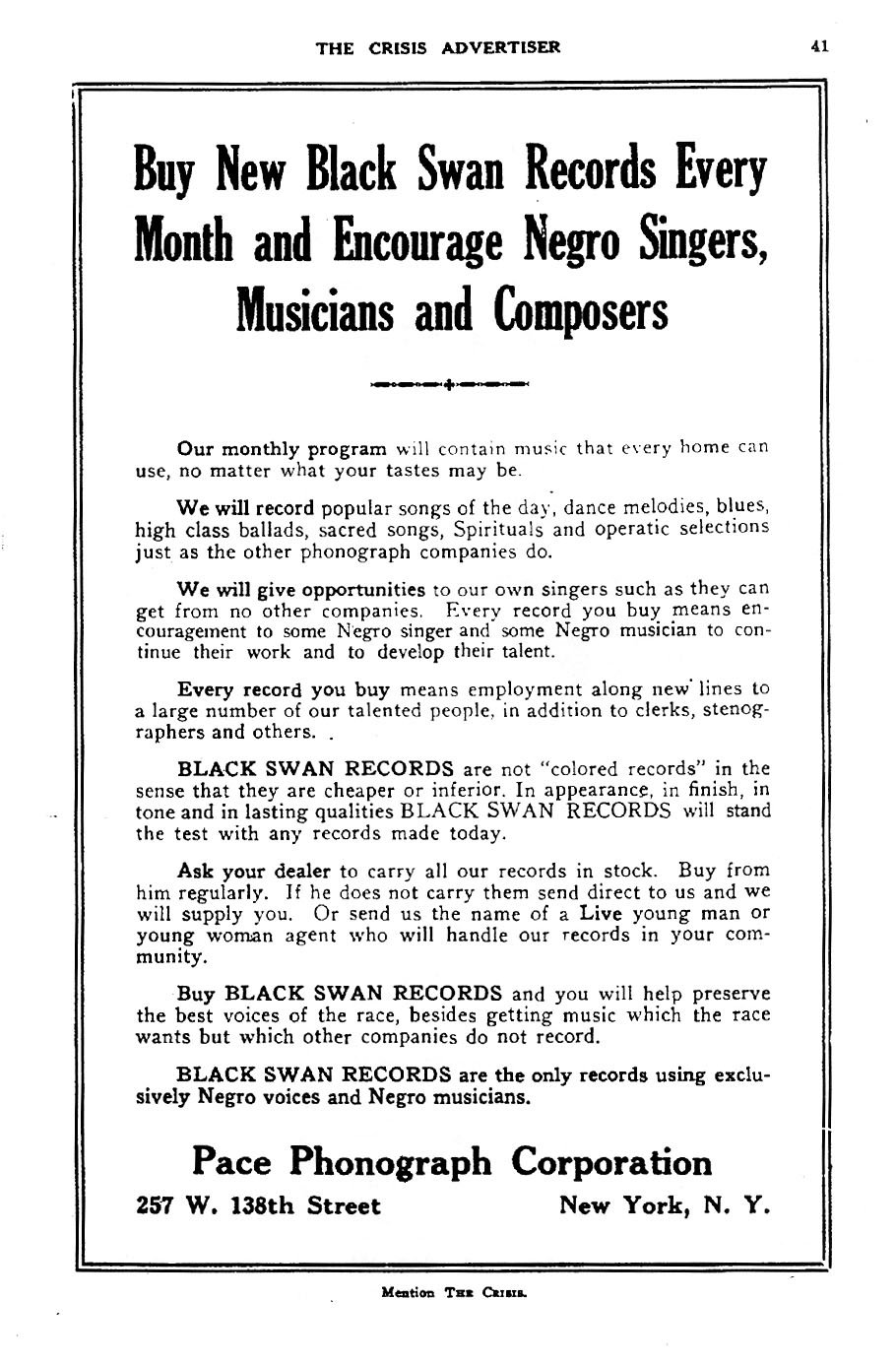
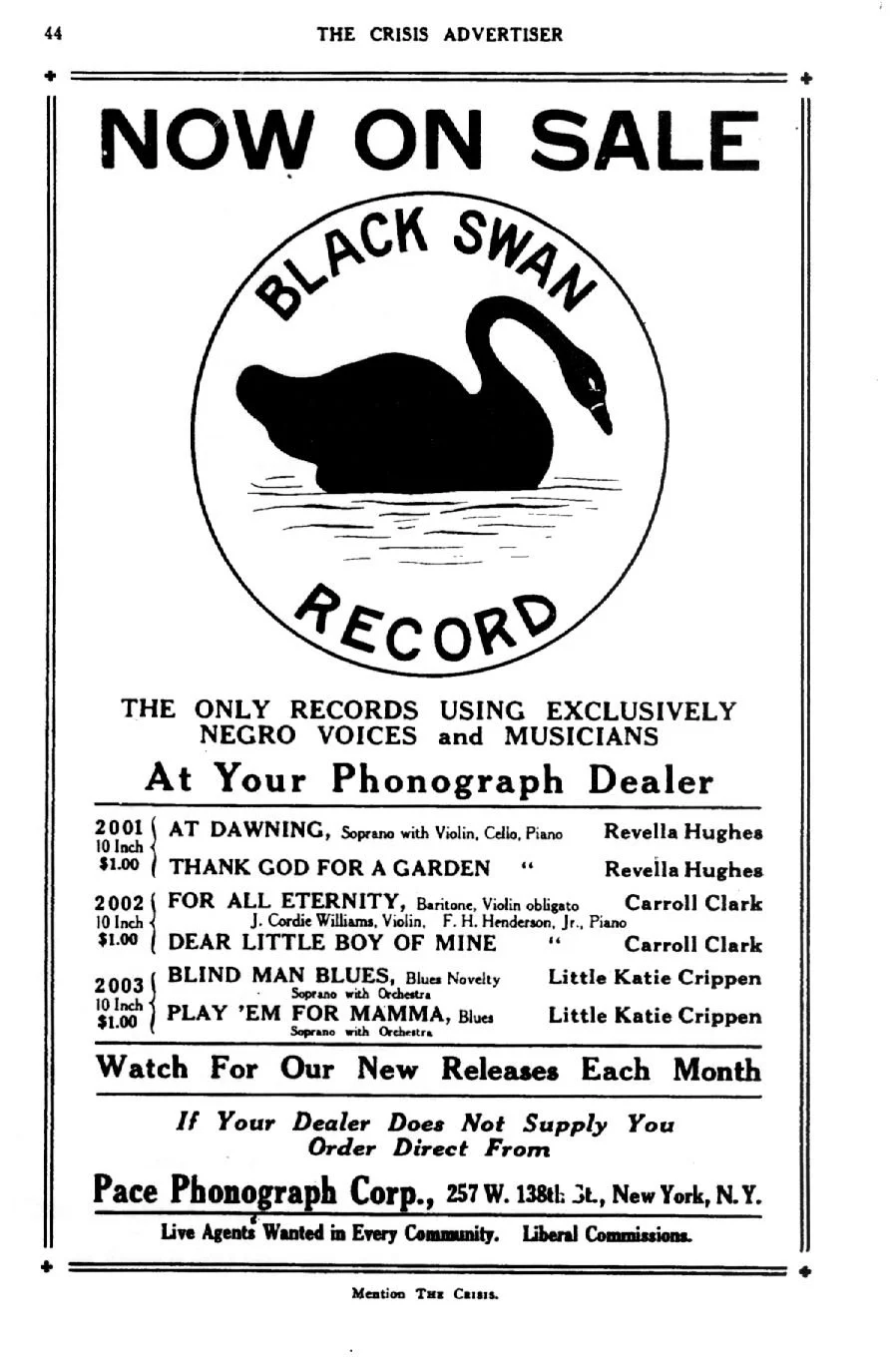
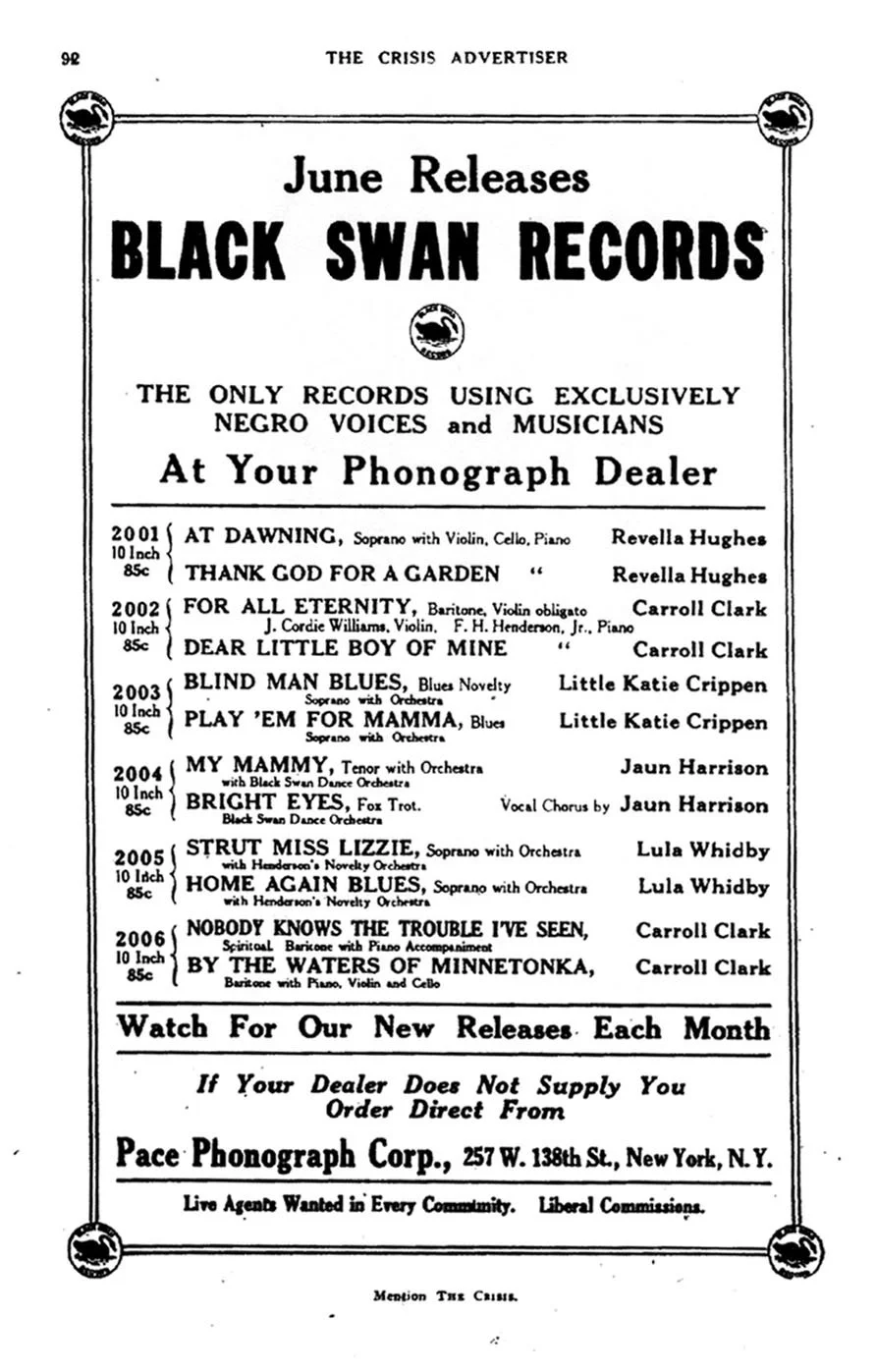
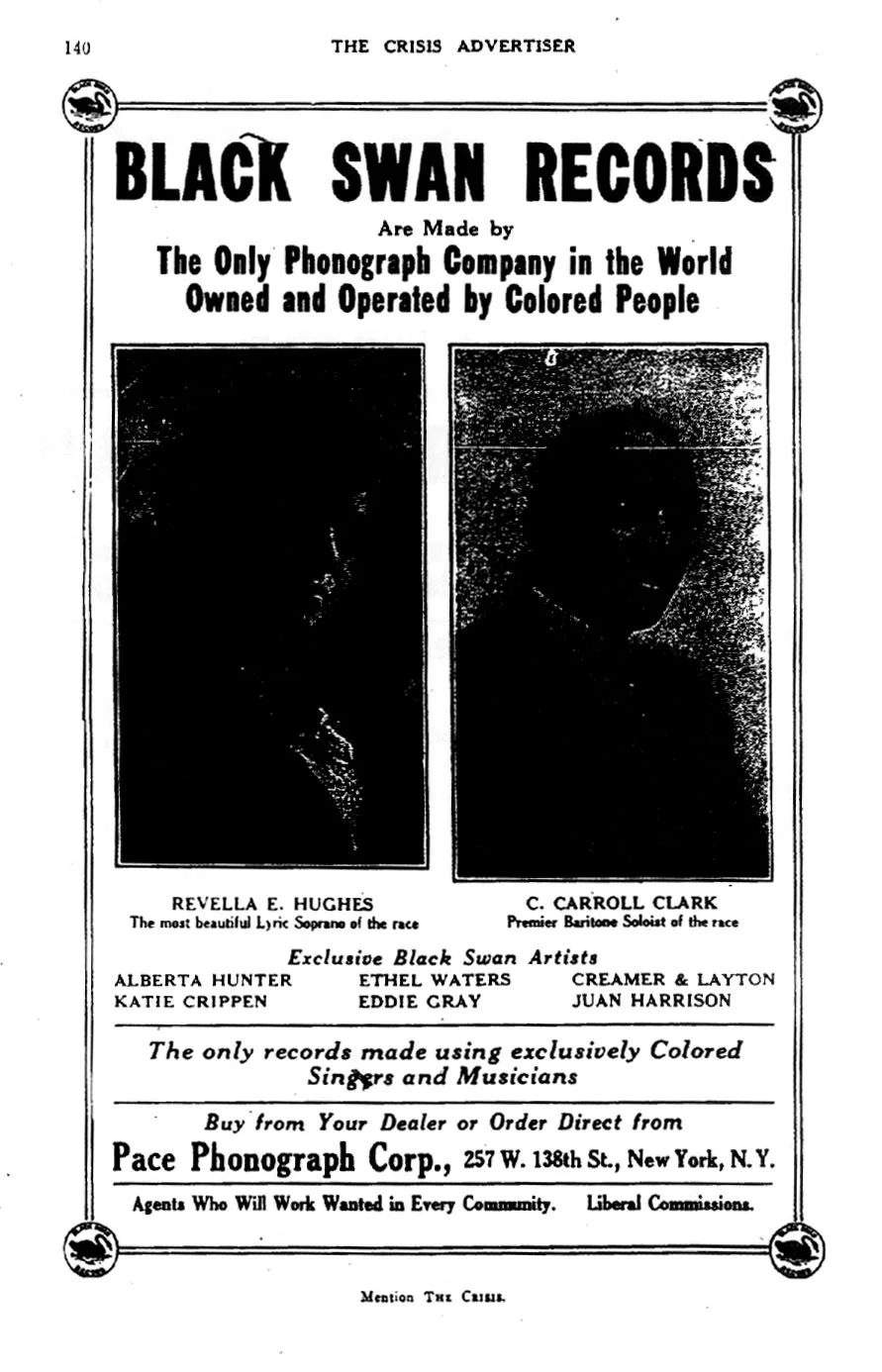
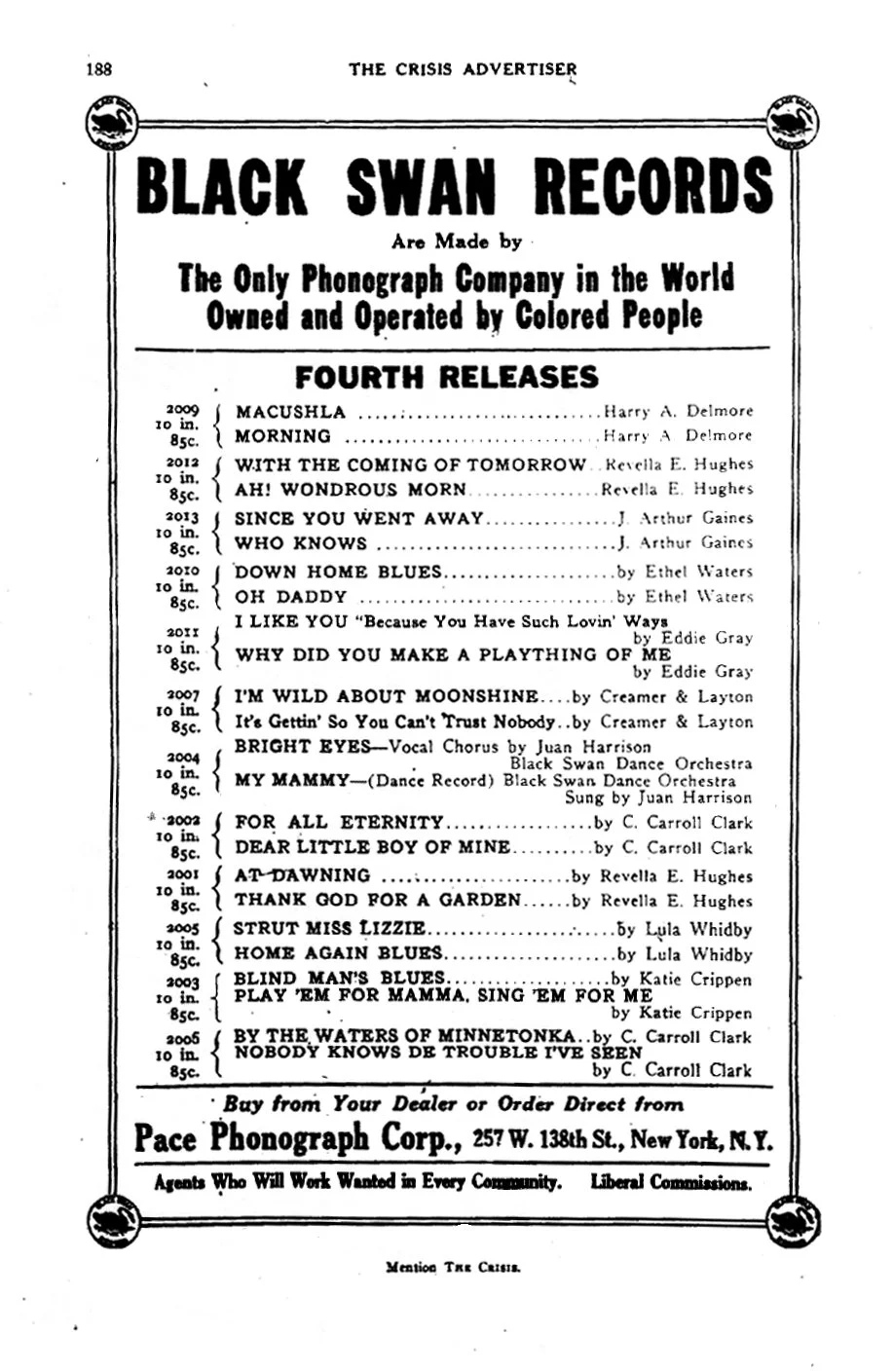
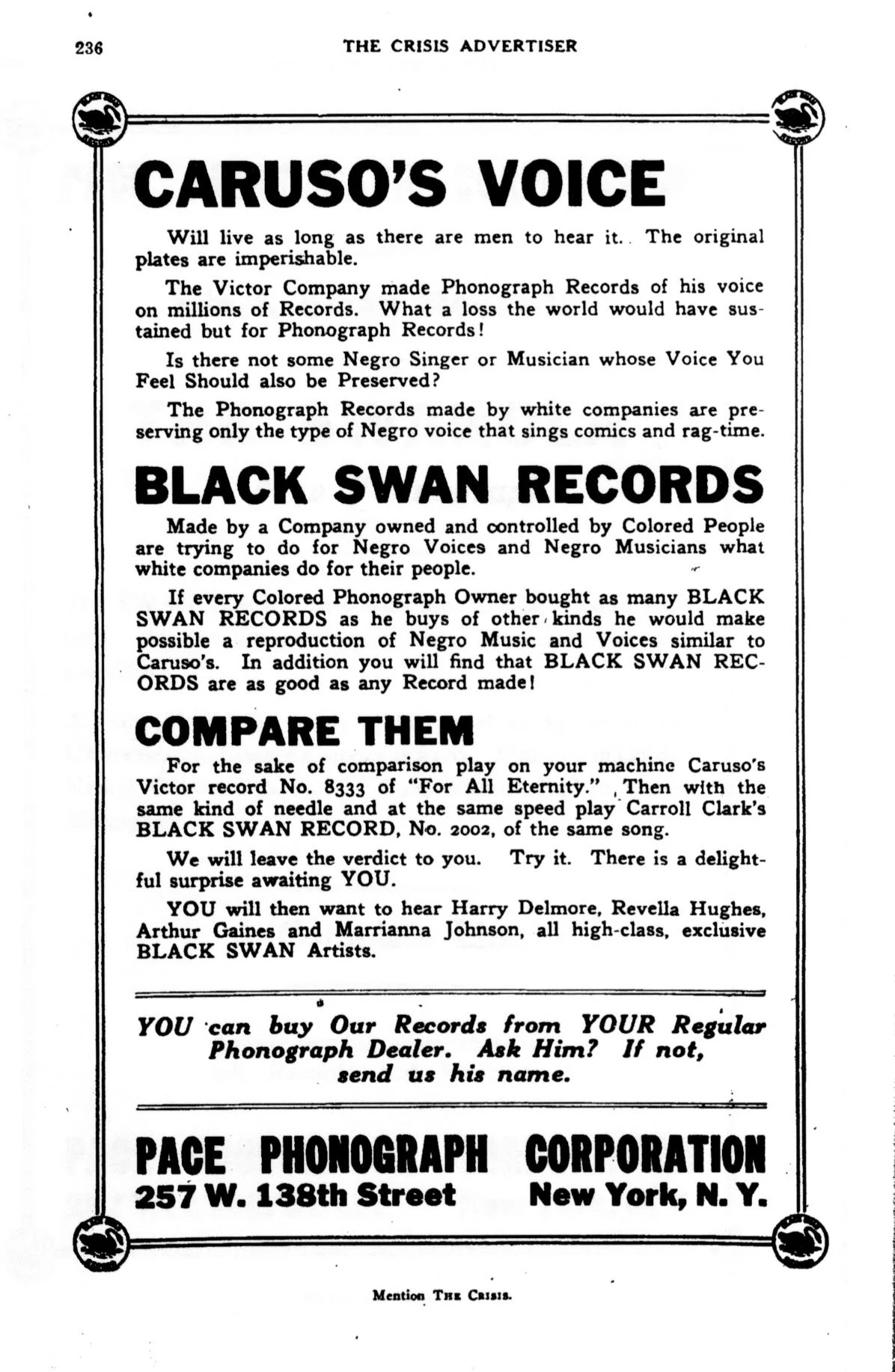
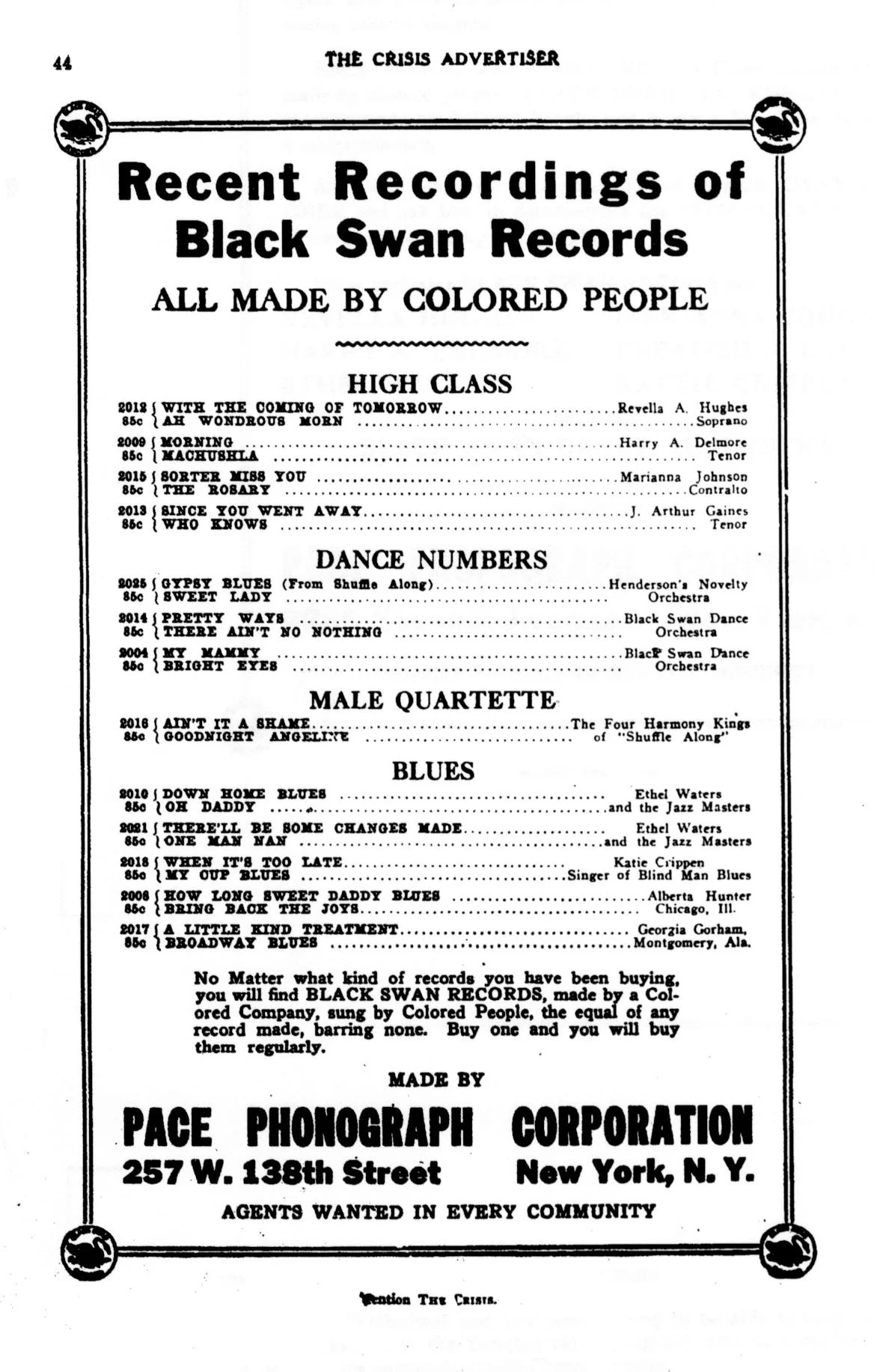
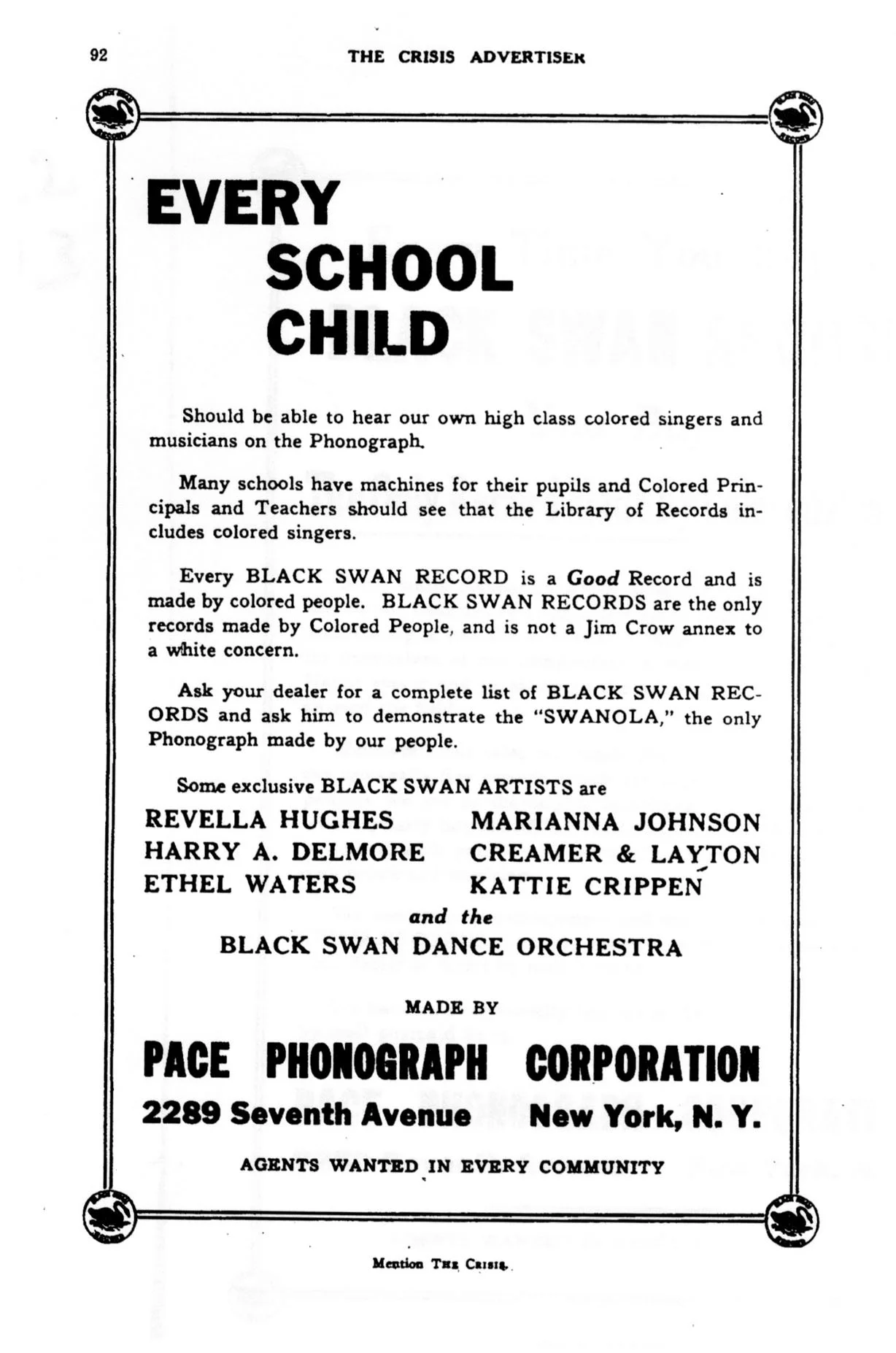
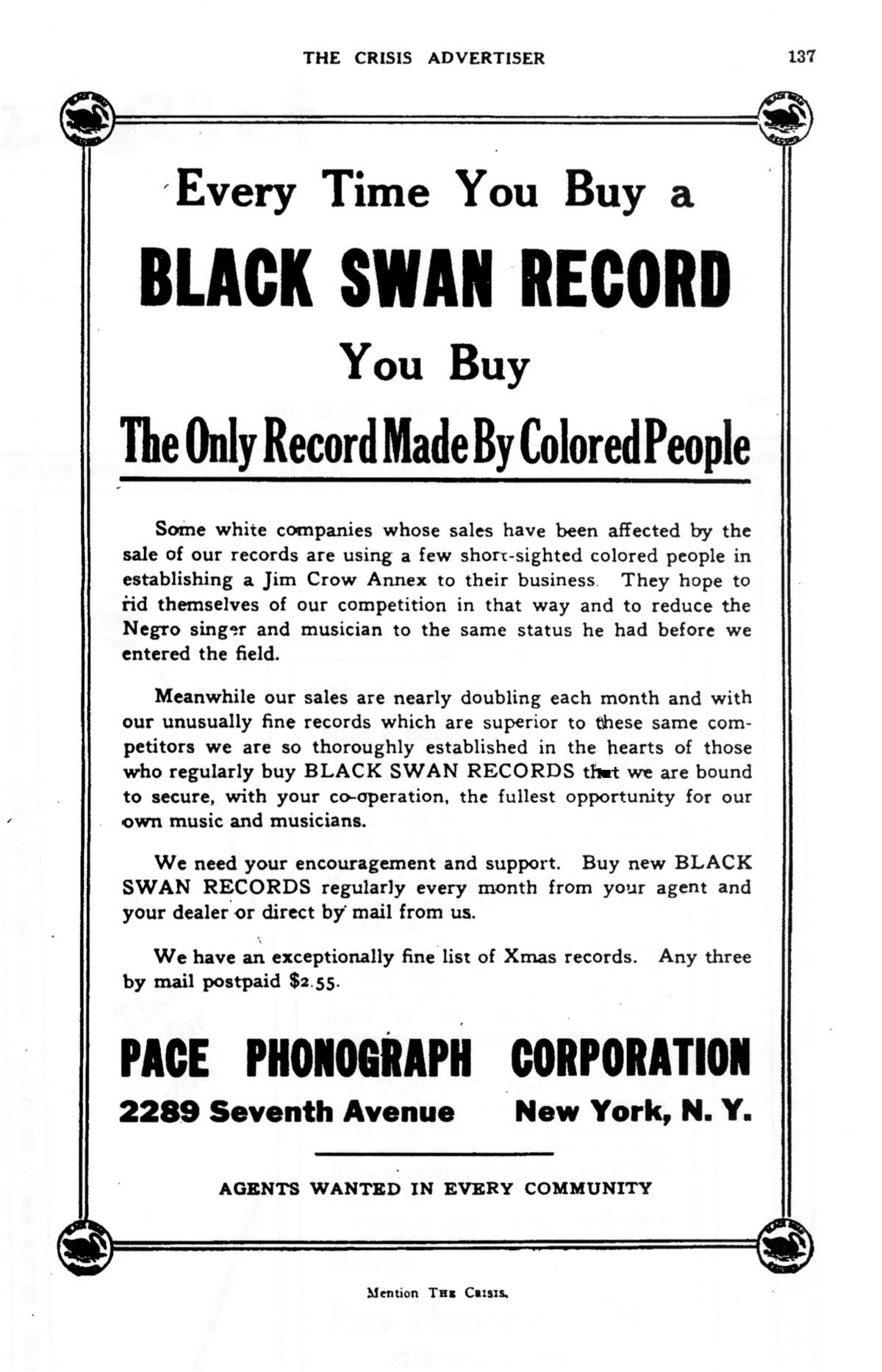
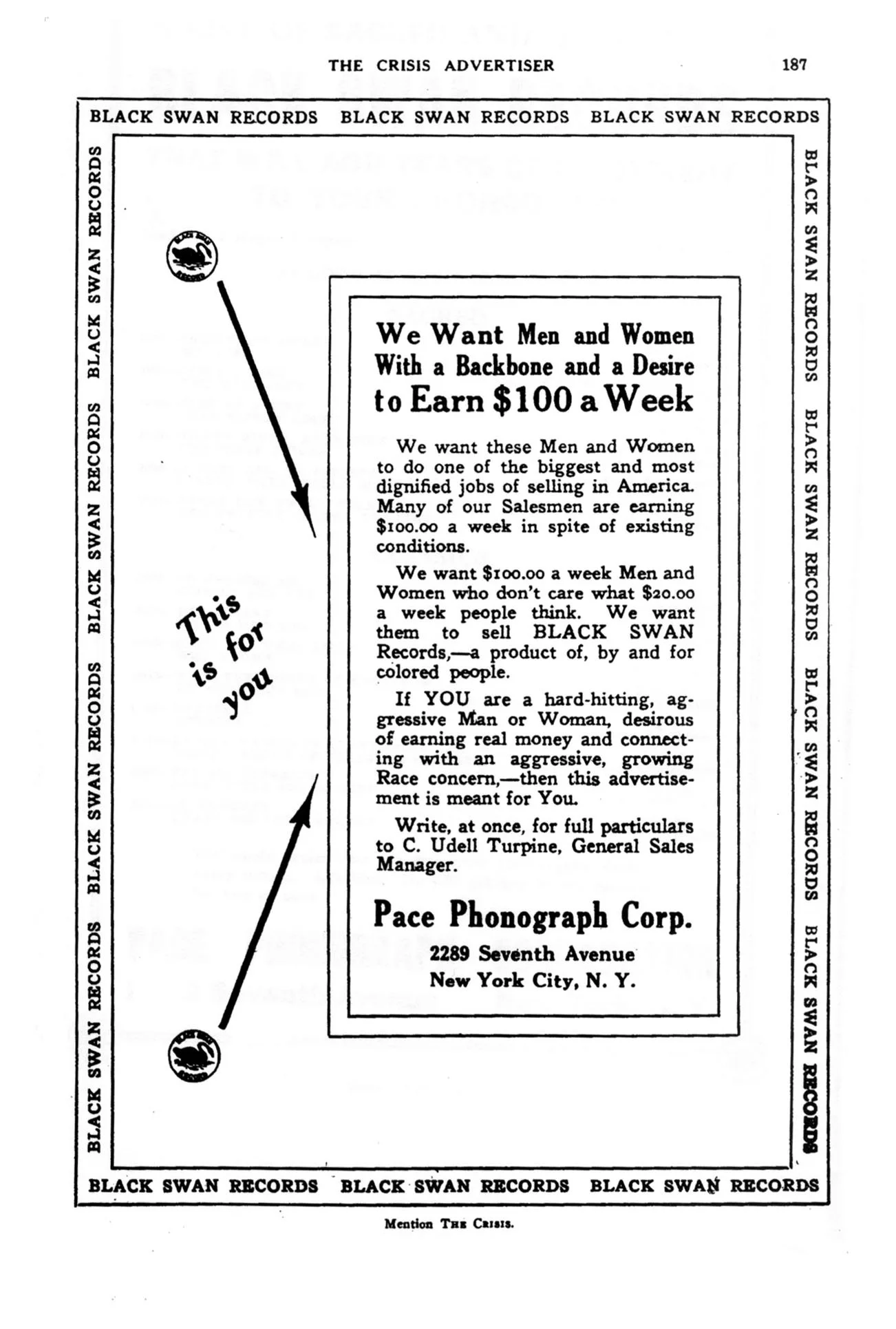
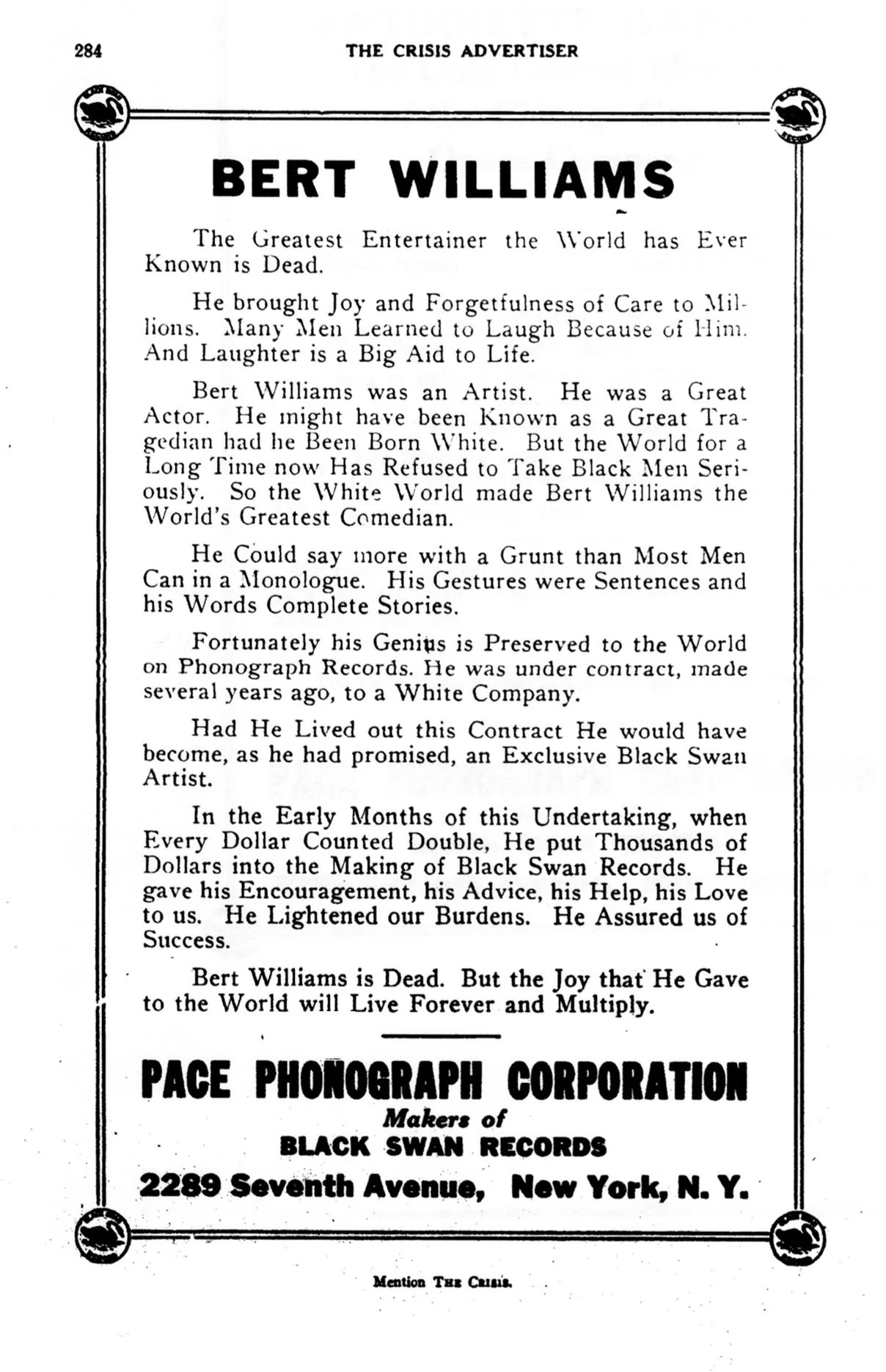
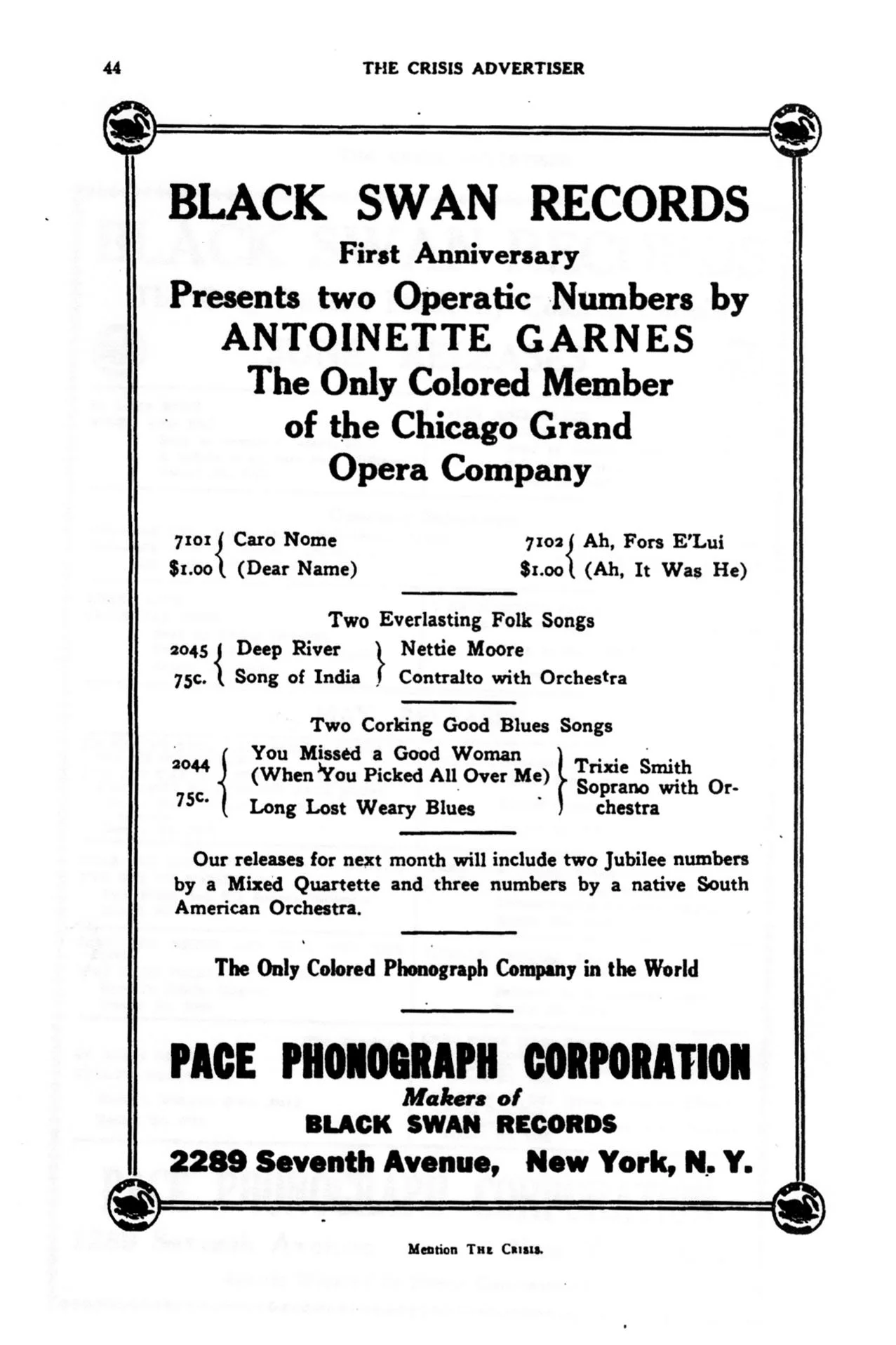
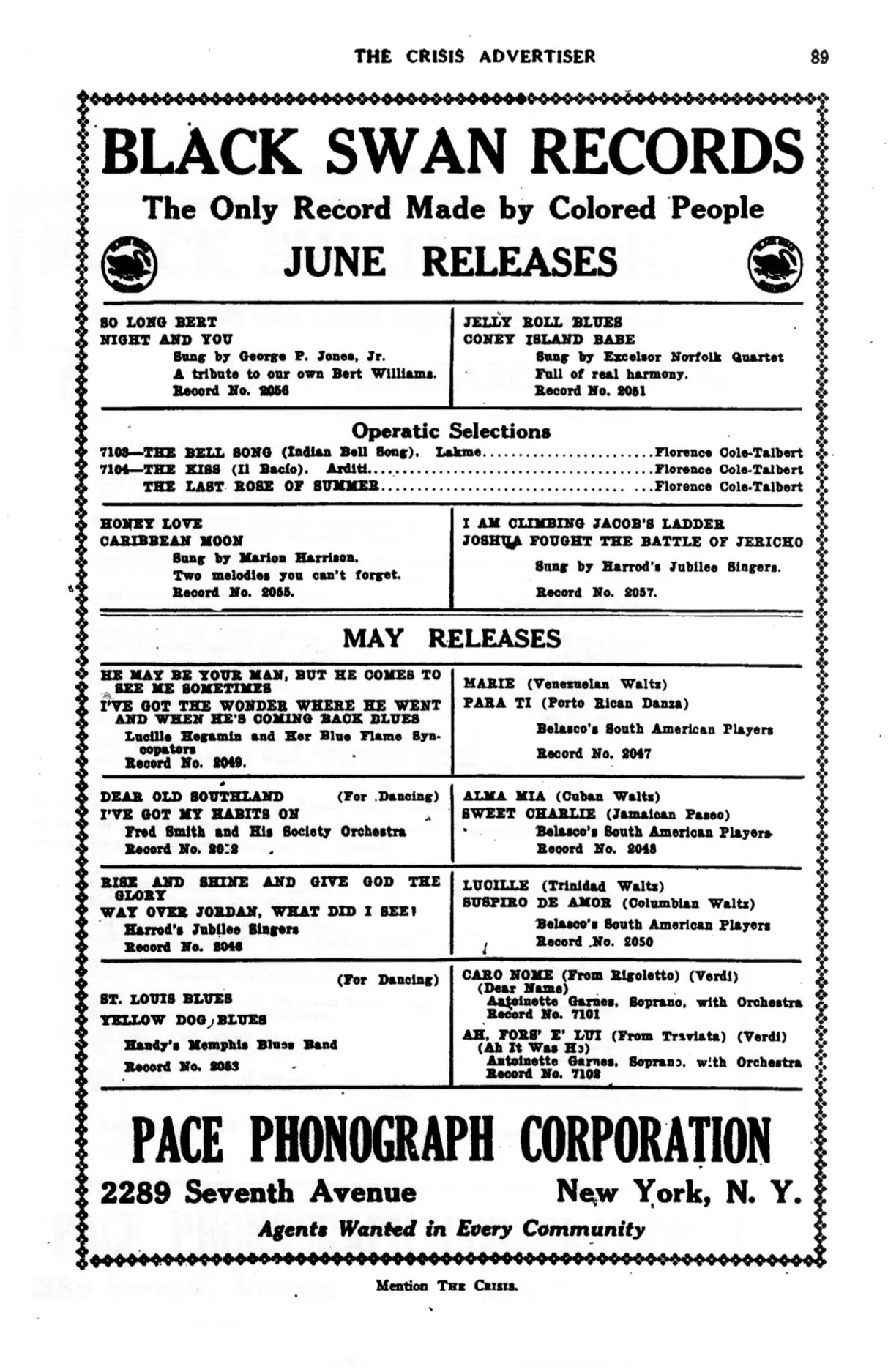
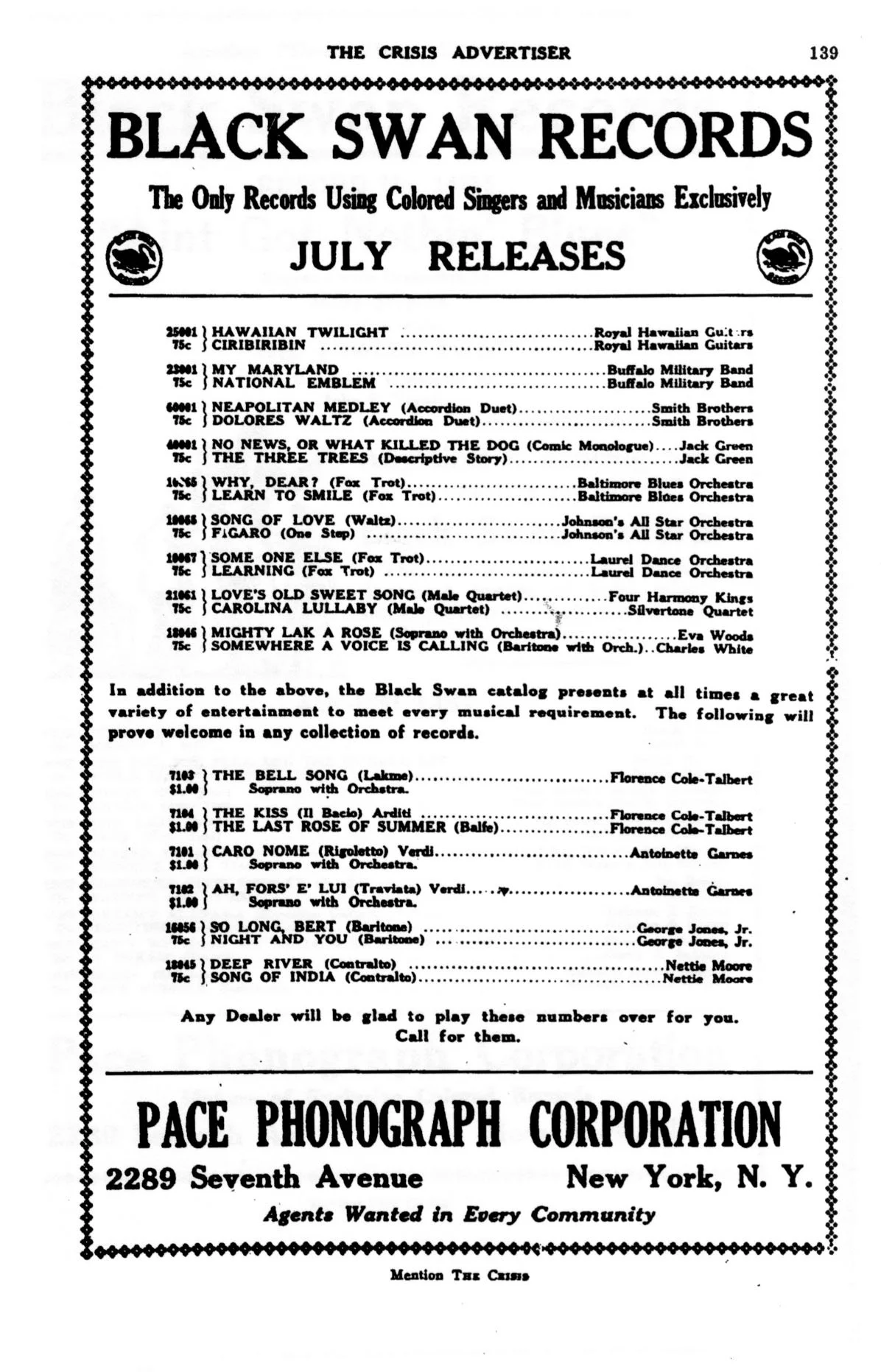
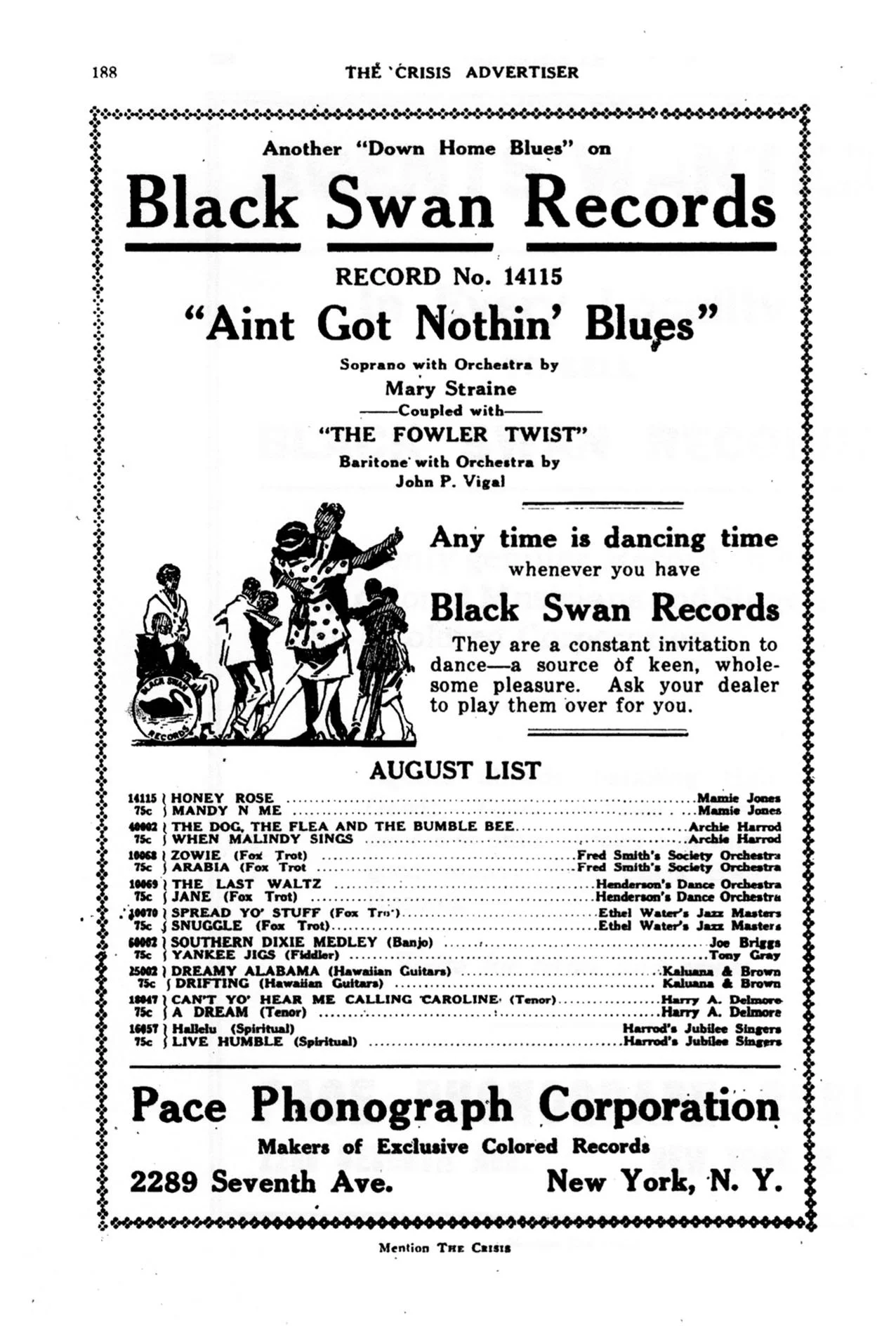
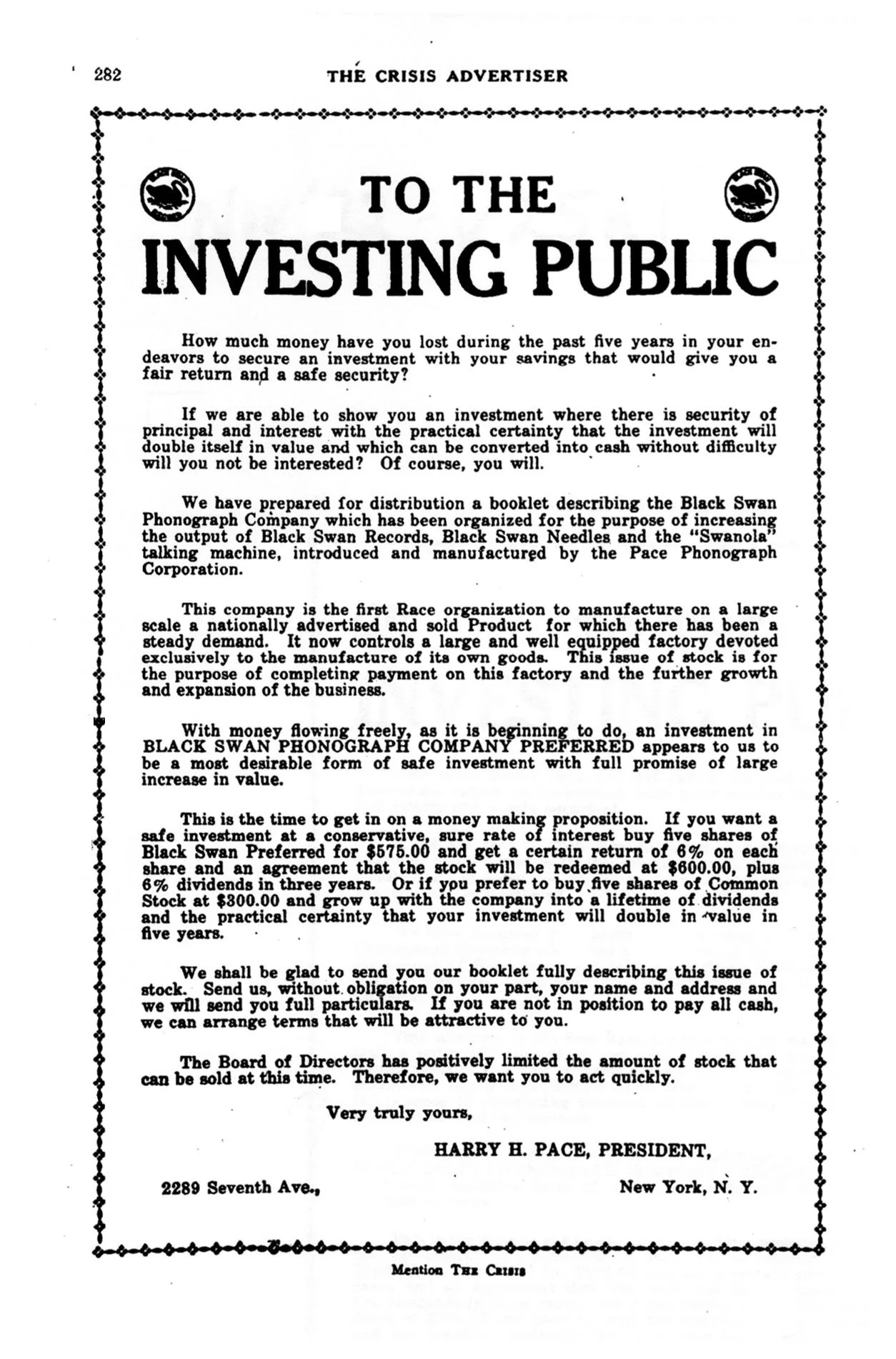
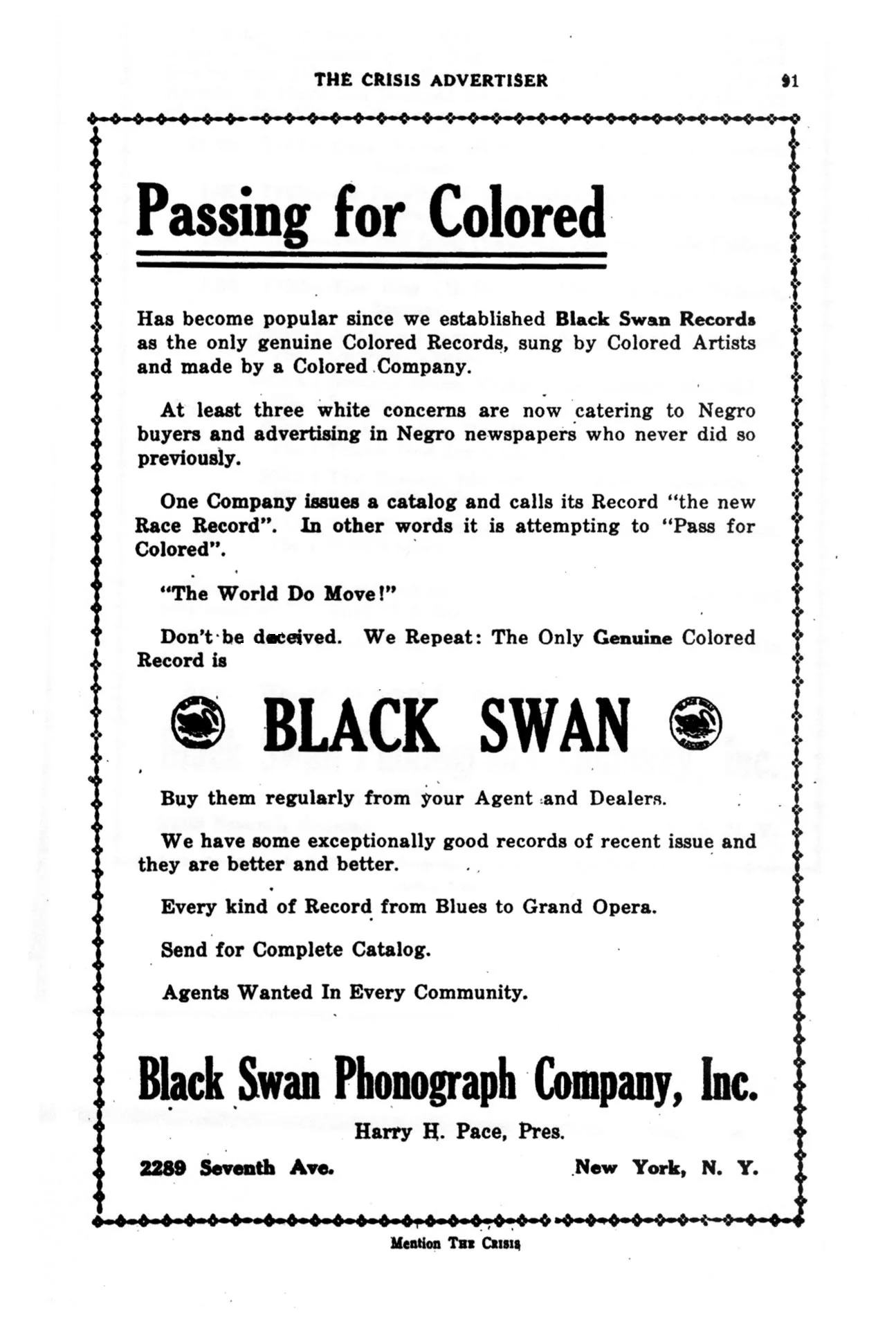
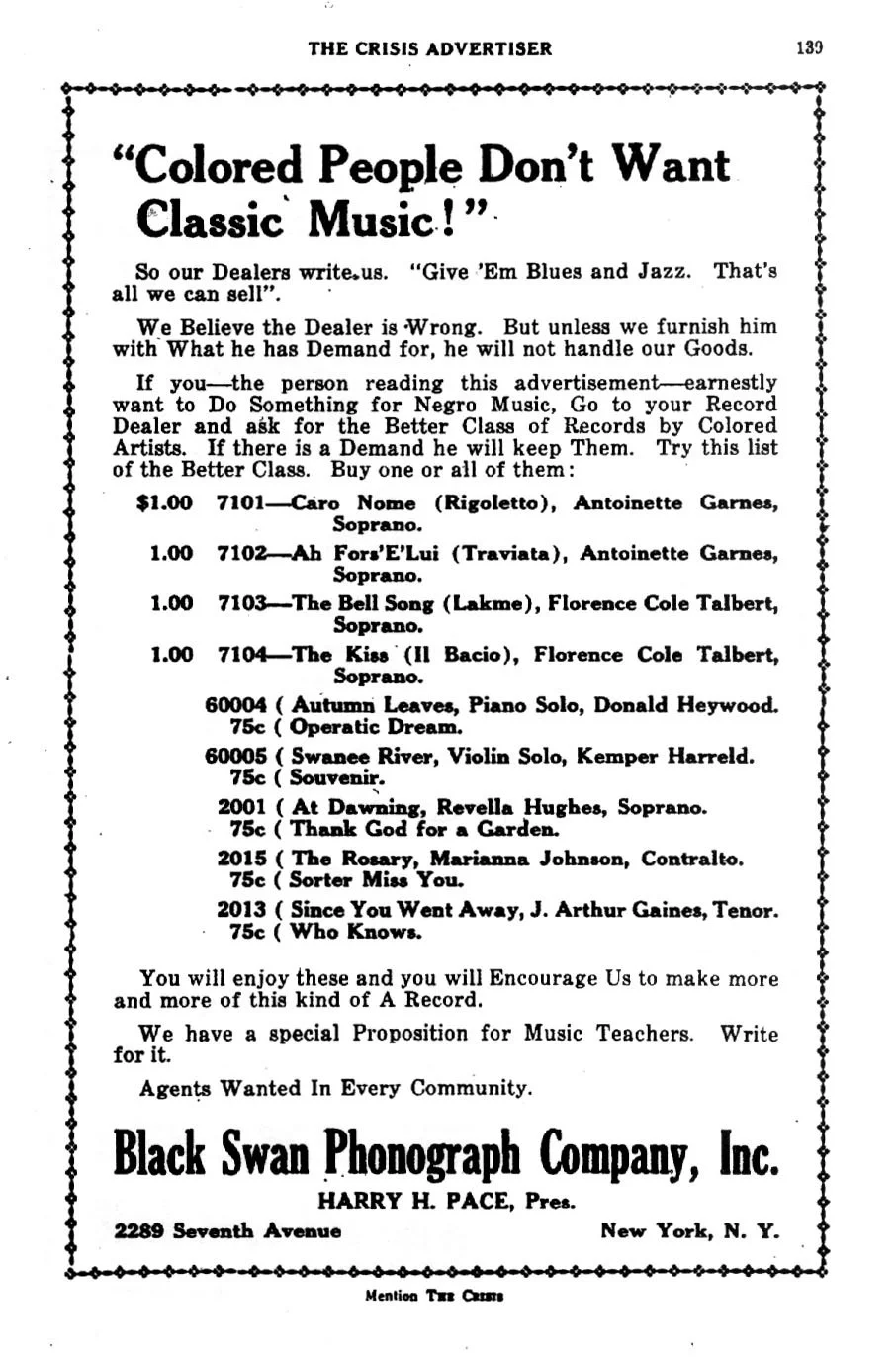
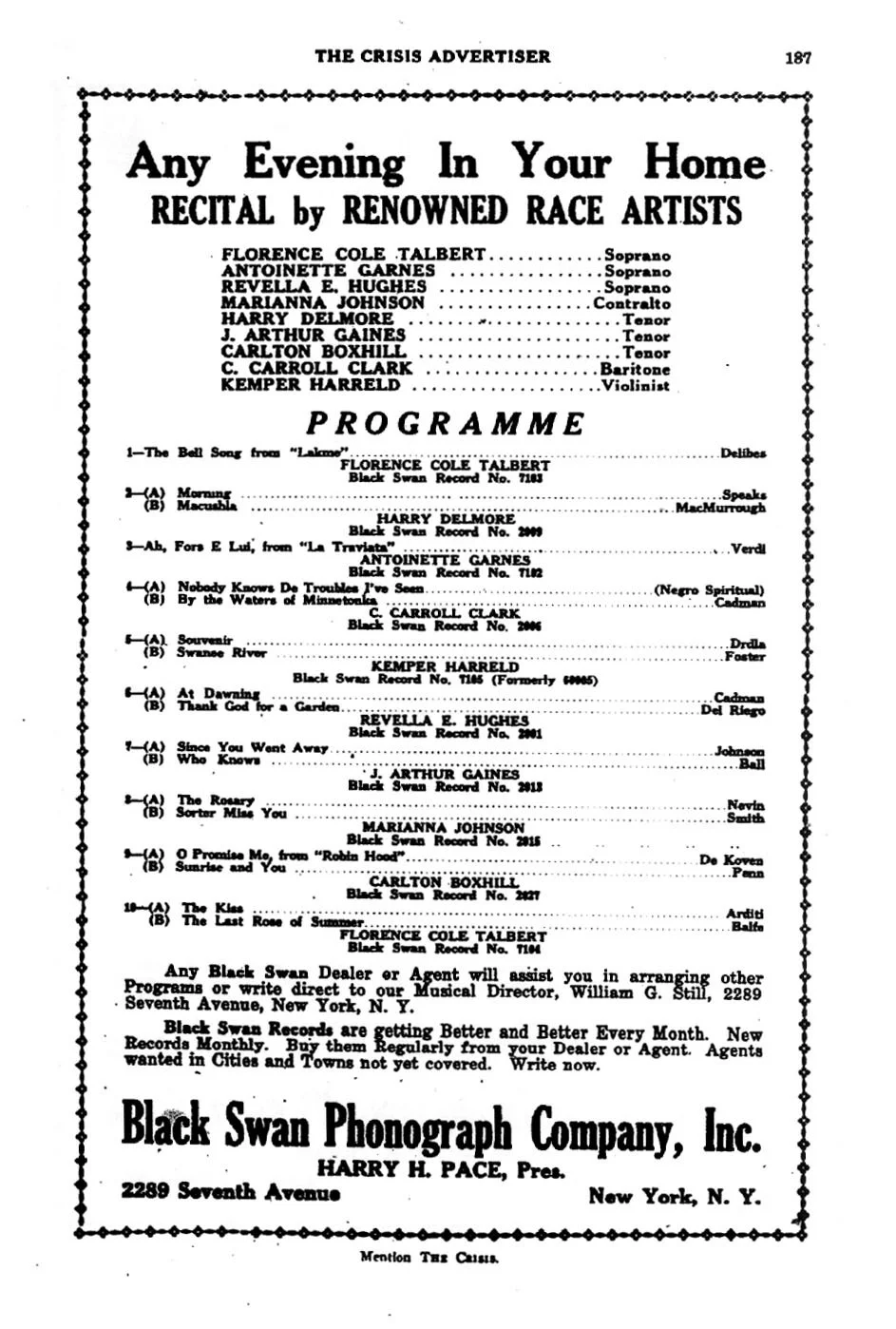
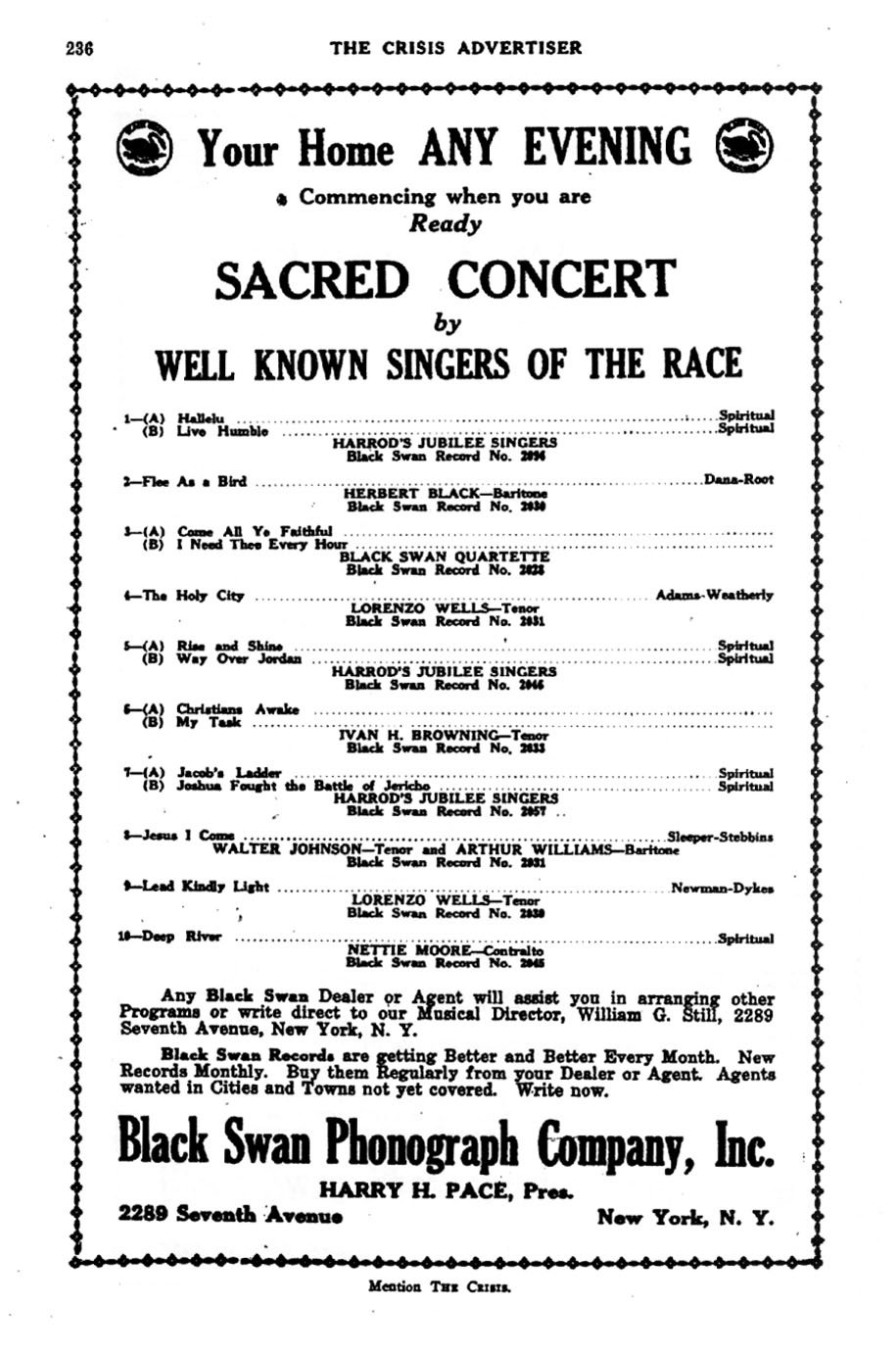
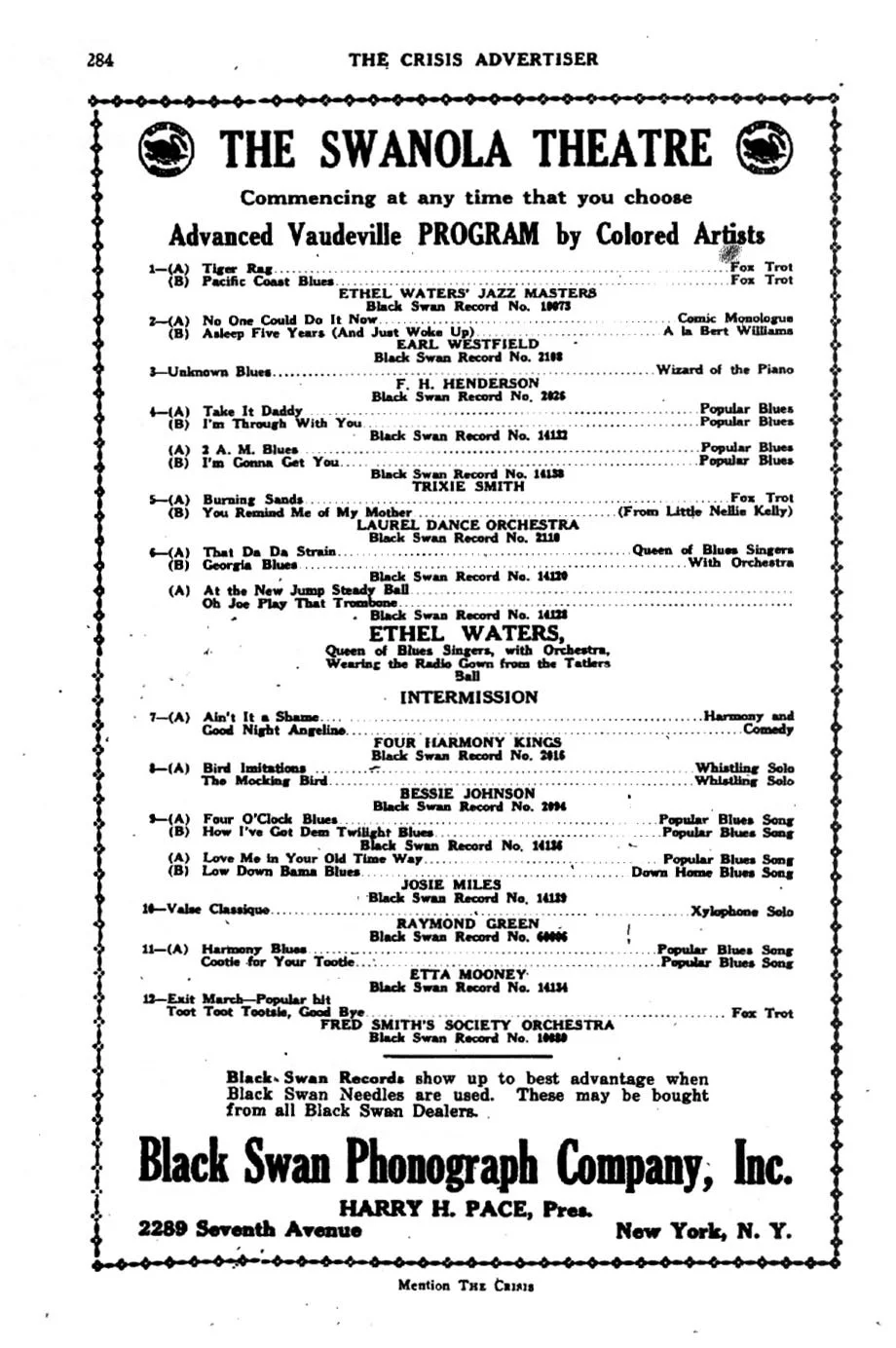
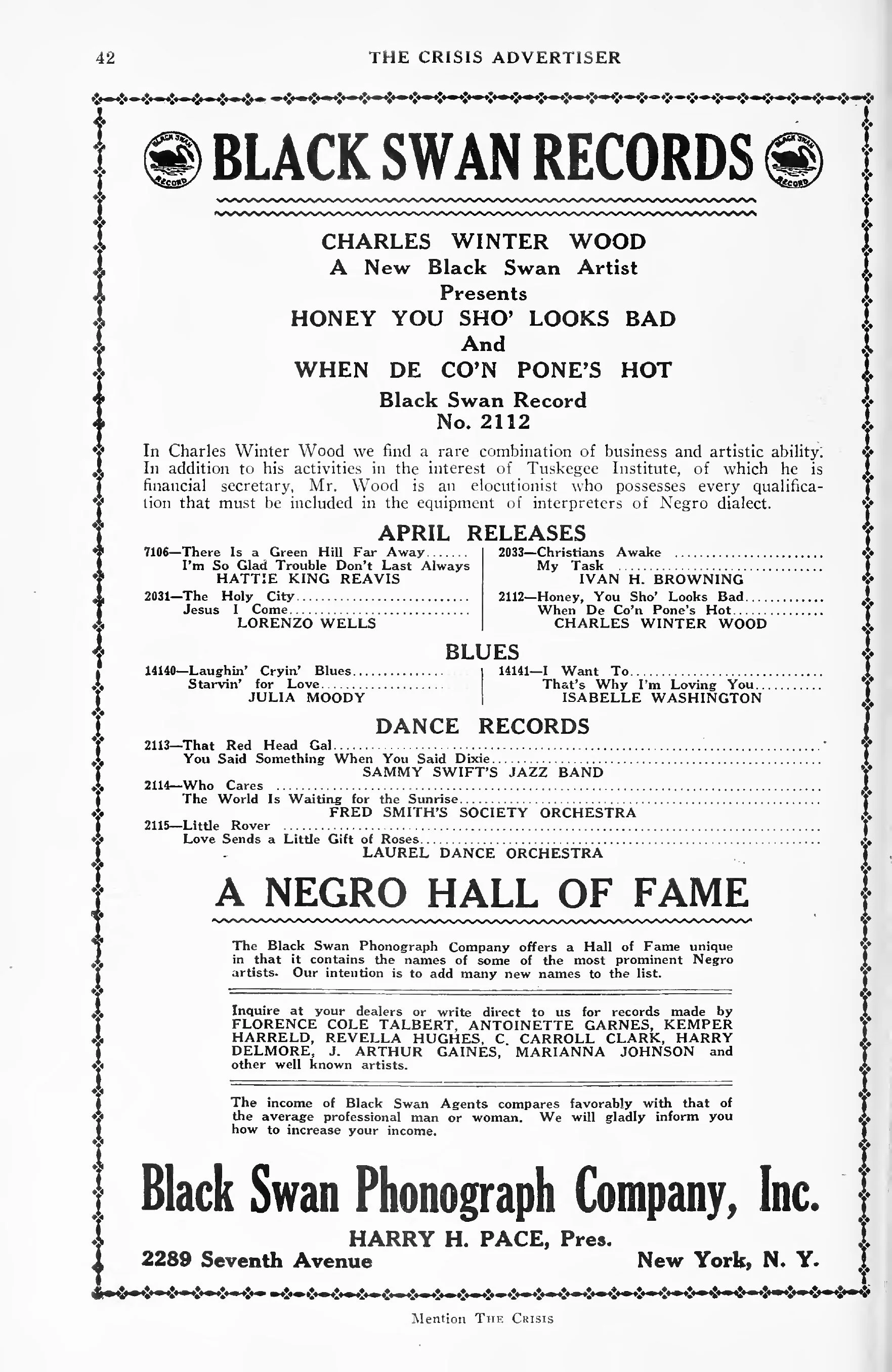
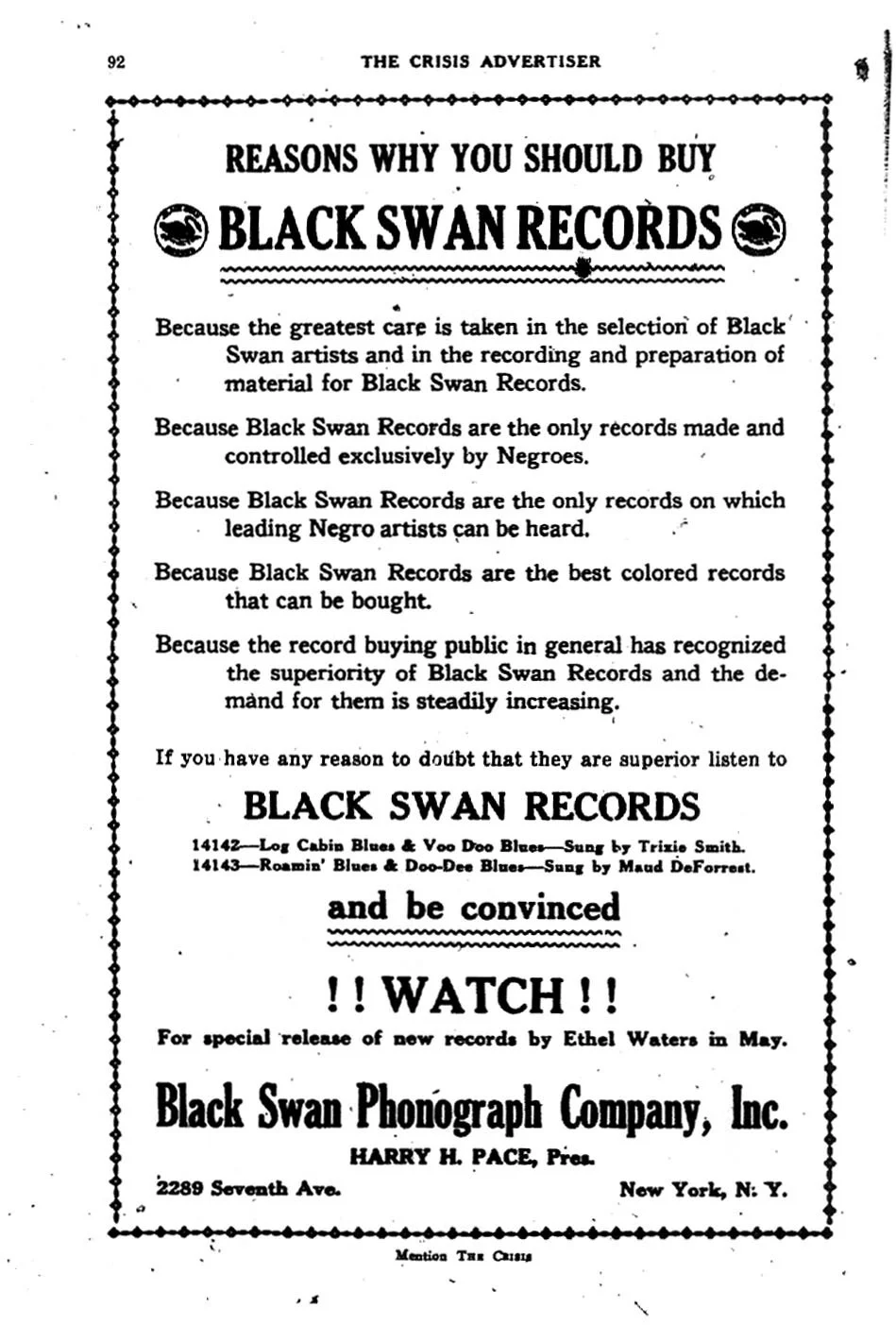
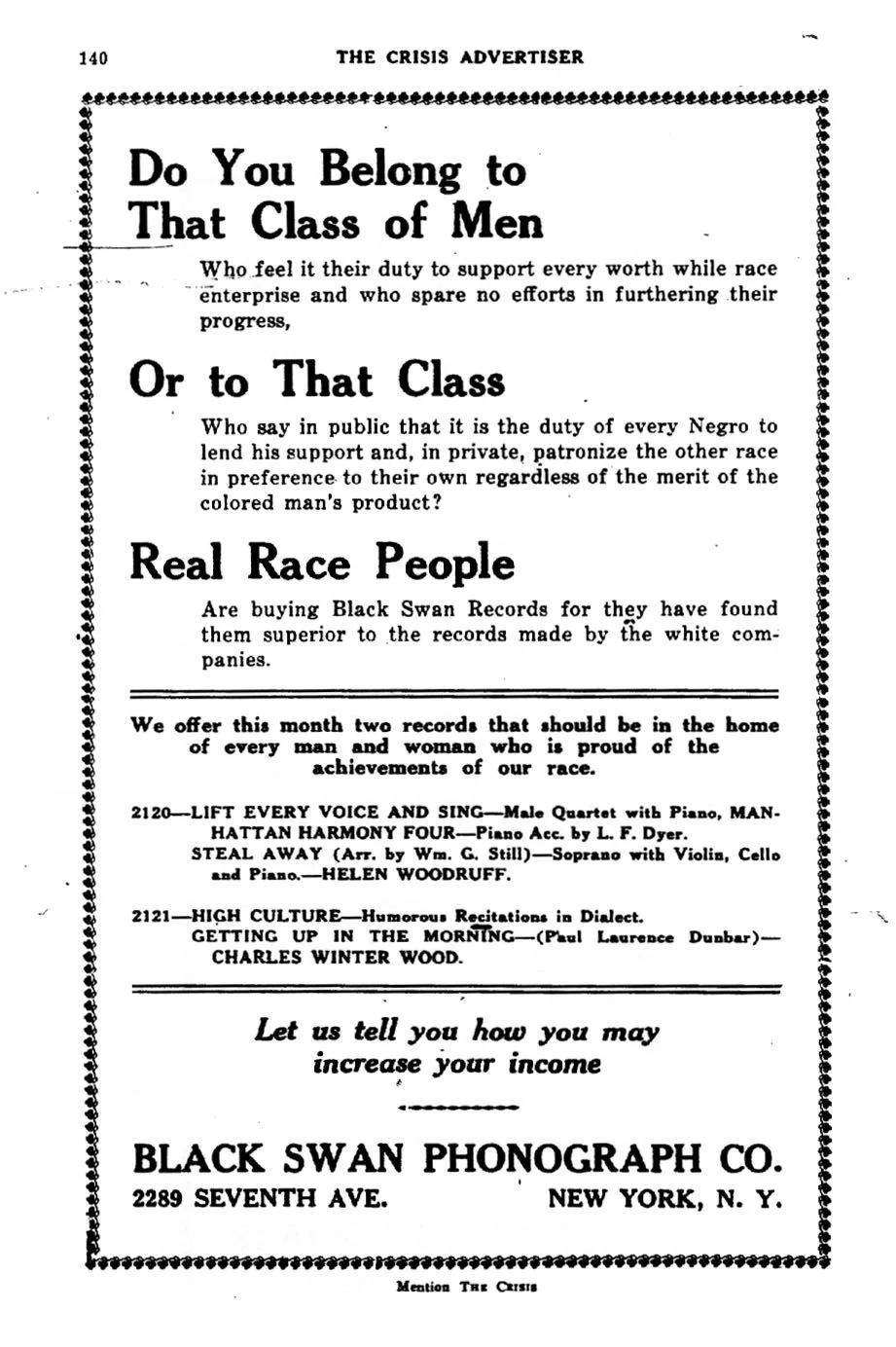
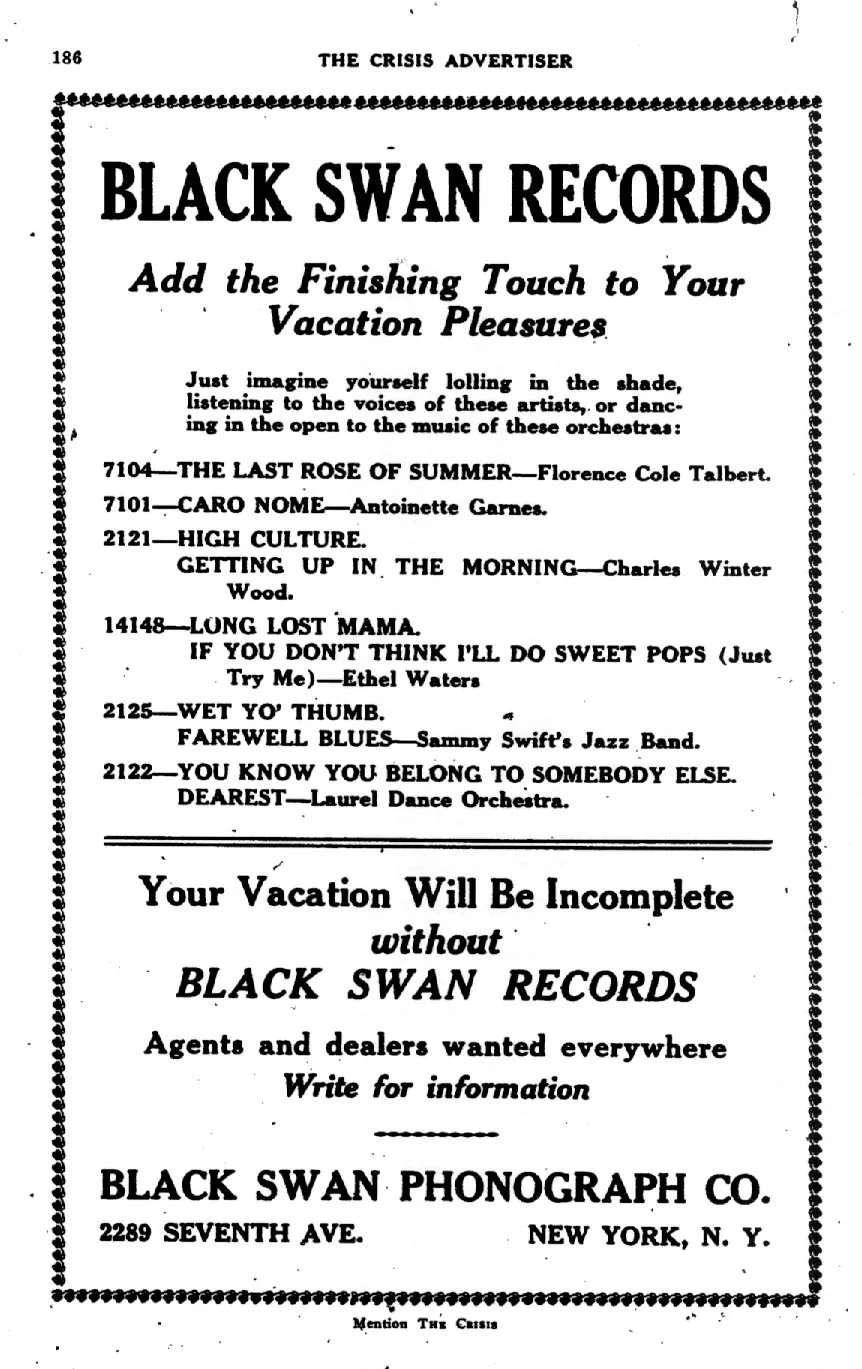
The chapter also discusses the unusual advertisements that Black Swan published in The Crisis, the monthly magazine of the National Association for the Advancement of Colored People (NAACP), and other African American political journals. Below is a complete run of the advertisements that appeared in The Crisis (courtesy of the Journal of American History).